
ENG 319 1.W: Herrick, Lanham

Today’s Plan:

  • Review Herrick (15 minutes Max)
  • Rhetorical Analysis: David Chapelle

Reviewing Herrick

On Monday I learned that 50 minutes goes by really quickly. If we are going to do all the things today, then we have to do this quick.

Let’s carve up and quickly summarize the Herrick article. Here’s how I usually divide it:

  1. Rhetoric and Persuasion (pg. 3-5). How does Herrick attempt to nudge our understanding of persuasion?
  2. Rhetoric is Adapted to an Audience (pg. 8-10)
  3. Rhetoric Reveals Human Motives and Rhetoric is Responsive (pg. 10-12)
  4. Rhetoric Addresses Contingent Issues (pg. 15-16)
  5. Rhetoric Tests Ideas (pg. 16-17)
  6. Rhetoric Assists Advocacy (pg. 17-19)
  7. Rhetoric Distributes Power (pg. 19-21)
  8. Rhetoric Discovers Facts and Rhetoric Shapes Knowledge (pg. 21-22)
  9. Rhetoric Builds Community (pg. 22-23)

I’ll give you five minutes to review your assigned pages and give us something specific.

Rhetorical Analysis and Dave Chapelle

Our main activity today involves rhetorically analyzing comedian Dave Chapelle’s November 6th Saturday Night Live monologue. I’ve created a handout to assist your note-taking, with the standard questions we associate with rhetorical analysis:

  • Logos
    • What is the argument?
    • What evidence is presented?
    • What is the nature of that evidence? Stats, scientific, personal experience, common wisdom, historic example)
  • Ethos
    • Who is speaking? Why are they credible? What kind of voice are they? What grounds their authority?
    • Who are they speaking to (and how do you know this)?
    • Who are “we” (are they speaking to us or to another audience through us? Or both?
  • Pathos
    • What emotions does the speaker feel? Assume we feel? Assume the target audience feels?
    • How would you describe the speaker’s emotional state/style?
    • What emotions does the speaker attempt to engender?
    • How do you feel as you listen to the speech?
  • Kairos
    • Why is now the right time for this speech?
    • What historic/contextual information would someone need to know to understand this speech in 10 (or 100) years?
    • What must we do after the speech is done?

As with any heuristic (system for generating ideas), not every element above might be useful/relevant to our object at hand. But these questions should help us think through the complexities of any rhetorical performance.

Here’s a link to the handout.

The Write Up

For next Monday’s class, you need to read Lanham’s essay “The Q Question” and write a one page, single-spaced response. Let’s revisit what I wrote about Write Ups in the syllabus:

But I also want to run this more like a graduate seminar–in which we are sharing ideas and learning from each other. Every week we do readings, you will be expected to share one Write Up with the class. What is a write up? It is a one-page, single-spaced, response to the day’s assigned readings. I will leave it up to y’all whether you do Tuesday or Thursday (week one everyone will turn in a Write-Up for Thursday). The first paragraph (¼ to ⅓) of the Write Up should offer a cut and dry summary of the reading. Standard stuff: what was the author’s intention/argument? What evidence does she offer? What changes does she conclude are necessary?

The next (⅓) of the Write Up should focus attention on a particular sentence/paragraph/section of the text. What should we, as a group, pay more attention to? What stung you, to use theorist Gregory Ulmer’s term? What resonated? What matters? What is bullshit? What do you want to pull against? Write ups are as much about reflecting on how readings made you feel as they are about logocentric response. Rhetoric, affect, response, responsibility, reflection. Throughout the course I will undoubtedly and obnoxiously thread words together.

Those two ⅓’s might add up to a whole. You might be out of room. Your page might be filled. But if it isn’t, then you can do the final ⅓: put this reading in conversation with something else you’ve read. Maybe a connection to something in this class. Maybe a connection to something from another class.

The aim of this class is learning. Write Ups aren’t formal papers–they are informal takes. They are snapshots of encounter and learning. They document struggle and success. You are free to experiment with style, voice, and language. If you don’t use “I” in these papers, then you are doing it wrong. They are personal engagements with the material. No one should be claiming universal mastery here.

As you read the Lanham, get in the habit of underlying key sentences. Whenever you do, write a word or two at the top of the page. Once you are done reading, flip back through the text and try to find connections between your notes and marginalia. What stands out? What are they key terms? The key themes to the entire essay? What is Lanham’s over-arching purpose?

The first paragraph at a Write Up is perhaps the most difficult: in a few precious sentences, you have to attempt to summarize the entire work. This is hard!

The other paragraphs should be more familiar to literature students; I am asking to close read a specific sentence or to. Contextualize it (place it in the stream of the over all argument), cite it, and then tell us why it grabbed you, why it is important, why you are skeptical, why it is wrong. In essence–what is a section of the text that we should talk about? Why?

The final paragraph can look at a second passage, or it can do something else. You can put the reading in conversation with something you’ve read for this class, or for another class. You can apply the reading to something in the news. Something you saw on a social media feed. As long as you are thinking, you can’t mess this up. You might open this section with “Reading Lanham made me think of…” You might tell us about a term in the reading with which you were unfamiliar, and what you found when you googled it.

For Next Class

I spent quite a bit of time Tuesday reading the Lanham, and I have decided to push back the due date on the first Write Up until Monday. In Friday’s class, we are going to start reading the Lanham together, so I can try and map out his argument and prepare you to read the second half of the essay on your own.

I will have a more detailed calendar for the course ready by Monday.

So essentially, there’s no homework for Friday unless you want to begin reading the Lanham on your own.
Posted in Uncategorized | Comments Off on ENG 319 1.W: Herrick, Lanham

ENG 225: First Day!

Today’s Plan:

  • Course Introduction
  • Attendance and Intros
  • Google Schedule Survey
  • An Intro to Ethics
  • Homework: Read Sicart, “Moral Dilemmas in Computer Games” and complete the Canvas Quiz (not really a quiz)
  • Homework: Purchase/Download The Walking Dead

Introduction to Ethics

Today I want to give some sense of what constitutes ethics. I’ll start by attempting to differentiate ethics from morals. Both ethics and morals are a part of what we call practical philosophy–rather than dealing with “what is,” practical philosophy deals with how we should act. In simplest terms, both the study of ethics and morals deal with right and wrong. Generally, morality is thought to deal with personal convictions developed via abstract or religious/spiritual principles. Morals can be stated as laws: “thou shalt not kill.” Ethics are thought to be rules derived from “external” agencies–our secular social/institutional contracts. Ethics are far more fuzzy and ambiguous, and often arise as questions that problematize morals. “Thou shalt kill if a solider in war.” And something can be ethical, but not moral and vice versa. Murder, then, is almost always immoral and usually unethical (except, for say, the soldier example, which we wouldn’t call “murder”). However, adultery is often immoral, but it isn’t necessarily unethical (while it is against our understanding of right/wrong, it isn’t something socially deemed illegal–even legally it is grounds for divorce but not prison).

This is the standard distinction between morals and ethics. I should say that I find this distinction between morality and ethics a bit too simplistic. I think of ethics otherwise. For me, morality is the study of the rules that govern our behavior, our internalization of the rules, what we value and believe. The spiritual-internal vs. secular-external distinction isn’t particularly productive for me. I don’t care if the rules come from state agencies or spiritual institutions. Again, morality is how we develop and internalize the rules: thou shalt not kill. A moral. I am not particularly concerned where the rule comes from or who enforces it.

Ethics, for me, signals how we employ, actualize, our moral values in lived experience. It is how/whether we (choose to) act. If morality is our sense of what should be, ethics is the study of how we actually act. Ethics operates in relation to morality, always in its shadow, and often in the places where morals break down. I think the study of ethics is the most interesting when we encounter a situation in which or moral convictions come into conflict. Again, if we believe that “thou shalt not kill,” then how do we also celebrate the soldier? How do we operate in the face of competing morals?

My understanding of ethics is heavily indebted to the work of philosopher Emmanuel Levinas. Levinas’s work encourages us to recognize our aversion to difference, and the lengths humans will go to eliminate alterity (that which is strange, different, unknown or unknowable to them). He jests that we have an allergy to the strange and different, to the other. We seek to “joyously possess” the world as a certain knowledge. Such possession is akin to mastery–to rule the world without question. To eliminate questions that make us uncomfortable. Rather than deal with the other, we desire the same–we desire to know, label, categorize, understand something. Facing something we do not know, or cannot know, brings out the worst in us. To be ethical, for Levinas, is to learn to inhabit this discomfort, disequilibrium and repress the desire to transform something Other into something familiar, what he calls “the same.” To welcome the other as an other, to let them be different, rather than to convert them into the “same” thing that I already know.

Ethics, for Levinas, is learning to recognize and prioritize others, to put their needs ahead of our own. Ethics becomes extra complicated when we realize that others make different demands on us–and no matter how generous we might want to be, we cannot give everything to everyone. To give to one other often means we have to take away from an other. Justice requires I choose between the competing demands of the other and the neighbor.

More than just an analytical science of how we act, ethics for me marks our ability to handle, to process, the unknown. How do we feel, and respond to our feelings, when we encounter the strange? Do we curl back in repulsion? Express exasperation (*why do they do that? that’s so weird?*). Or do we become self-critical? Do we invite reflection (*why don’t I do that?*).

How/do we welcome the stranger? Something different? Further, what happens when we encounter something we cannot control, when we have to make a decision with no clear right answer, when we face something that resists our mastery?

What does this have to do with the distinction between morality and ethics? I believe that the more we recognize and study ethics (as moments of moral indecision), the more we learn to choose when no one true, certain, “right” answer is evident, available, or even possible, the more ethical–the better people–we will become.

Our first major project, which will cover the next 5 weeks, questions whether games, by constructing *sophisticated* ethical problems, can make more ethical in the Levinasian sense I have just worked out.

Let’s Talk Trolley Problem

Let’s talk about the Trolley Problem, created by Foot and complicated by Thompson. Very simply: the trolley problem is a philosophical thought experiment created in the 1970’s by philosopher Philippa Foot. If you have a laptop or mobile device in front of you, then click the following link.

Let’s play 4 quick choose your own adventure games.

So, if you haven’t guessed by now, here is my theory for what video games have learned is their unique province: they can leverage the emotional unrest, affectation, difficulty, disequilibrium of Trolley Problems. Foot’s trolley problem is meant to explore the moral consistency, or lack thereof, people use to make life or death decisions. Some video games “proceduralize” this thought experiment, to make it more visceral or “real.” We feel the decision–this kind of feeling is called “affective” or pathetic (deriving from the Greek term for emotion, patheos).

In a book or a film, we are left to watch the trolley driver pull the switch or not. The author decides. The author justifies. Perhaps she does so to secretly stir our outrage, to get us to deconstruct her flawed reasoning. She can spur reflection, contemplation, resistance. But we are always a bystander to the action, distanced from the choice. We are witness.

But not so in a game. I remember my first play through of Dragon Age: Origins. The details are a bit foggy–I remember encountering some elves and some werewolves. Maybe the werewolves were created by dark elven magic? And then, like Frankenstein’s monster, abandoned by their creators. Or maybe a wolf had killed and assaulted an elf? I honestly don’t remember. But I remember, unexpectedly, having to decide which species to exterminate. Only one can survive. Neither is innocent. And there is no heroic path to saving them both. I am responsible. I must pull the lever.

I’ve played games since roughly 1984 on my Atari 2600. I’ve murdered hundreds of thousands, if not millions of aliens and demons and terrorists and zombies and horde (“For the Vangaurd” or “For the Alliance!”). I’ve killed all these things from a moral position that authorizes their death. I’ve never been troubled by all this killing. Those aliens threaten our light. Those demons threaten Tristram. Those terrorists threaten democracy. Those zombies would eat me and the few others remaining in Raccoon City. I killed them all without friction. (Save for Silent Hill 3, one of the greatest mindfuck games of all-time unfortunately lost to history).

But Dragon Age interrupted my joyous possession of the world, my righteous action, my moral foundation. It stung me. This was something different.

I introduce the Trolley Problem, the lever, the notions of disequilibrium, ethics, and agency as a way of thinking about games. I imagine many of you are already thinking of games that leverage this dynamic. Soon we will work together to generate lists of games–AAA, mobile, indie–that we can play and explore as a class (in addition to my required experience: Walking Dead episode 1).

Posted in Uncategorized | Tagged , | Comments Off on ENG 225: First Day!

ENG 301 1.M: Introduction

Today’s Plan:

  • Syllabus
  • Sketching Out the first project
  • For Wednesday: ABO book on emails, introductory email

Syllabus

Yeah, it is boring and cliche. But let’s start with the syllabus.

Also, let me share two things:

  • You will need a Gmail / Google Drive Account (I’ll be sharing a lot of documents via Google Drive, and will ask that you share documents with me). I generally do not accept Microsoft Word documents in this class (you need to learn to work in collaborative, online writing environments).
  • If you do need to send me a .docx, for the love of the gods, please change the file name to something specific, rhetorical, and meaningful. For instance, I generally name all my files santos-titleofthing-semesterandyear, for instance, santos-kairos-book-review-sp2021. I will judge you on this (which is only kinda sorta a joke).
  • Canvas Files and Discussions (most class readings will be available as .pdfs via Canvas)

Brumberger and Lauer on Jobs

Our first project is rooted Eva Brumberger and Claire Lauer’s article “The Evolution of Technical Communication: An Analysis of Industry Job Postings.” As we revise UNC’s writing minor, I have been curious as to what skills and technologies to focus on. This curiosity led me to research job advertisements for English majors, and Brumberger and Lauer stands as the most recent and comprehensive study I found. However, their article focuses on “technical communication.” This designation can have many meanings–sometimes it is merely a synonym for professional writing. But not in their case–they use (as do I) in the more precise sense of developing documentation (instruction manuals), product testing (usability reports), and working with scientific experts to communicate scientific/technical knowledge. Our department doesn’t have someone with those specializations–so as much as I appreciate their research, I wanted something a bit more relevant to a smaller department. Their research speaks more to folks at large research institutions with Professional and Technical Writing major, more specialized faculty, and software licenses such as MadCap Flare or Adobe RoboHelp. We are a much smaller department with 5 tenure-track faculty (and none of us, I think, would claim Professional or Technical writing as a core specialization). So my research question is: what skills, technologies, characteristics should we focus on to maximize your preparation for today’s job market?

In answering that question, I’ve turned my attention to Professional Writing jobs outside of technical writing. During my research, I came across a specialized job listing site–mediabistro.com. From their “About Us” page:

Mediabistro is the premier media job listings site and career destination for savvy media professionals. Whether you’re searching for new job opportunities, striving to advance your career, or looking to learn new skills and develop valuable expertise, we are here to strengthen and support your professional journey. We have the tools and resources to help you navigate your own path and find career happiness.

Rather than turning to a more popular site like monster.com, I used mediabistro.com because it focuses specifically on jobs involving writing and communication. It brands itself as a job site for creative people. I thought this would be a promising site for majors and minors who did not have extensive training in technical writing.

I spent the month of June 2017 scanning every job ad posted to mediabistro.com. I filtered out jobs that:

  • Called for experience in television production (especially those that required years of on-air experience)
  • Called for extensive experience as a field journalist (although I retained jobs open to those without journalistic experience; a few jobs were looking for bloggers or content contributers)
  • Required degrees in finance or accounting
  • Required extensive experience with Google Ads and/or other Customer Relationship Management (CRM) softwares (Salesforce was particularly popular)
  • Required applicants bring a client log with them
  • Required management or hiring experience (the term management is quite slippery in adverts; sometimes it means “manage a team” and clearly indicates the need for leadership experience. Sometimes it means “manage our twitter account” and isn’t, per se, a leadership position)
  • Required backend coding skills
  • Required extensive graphic design portfolios (I did retain entry level graphic design jobs)
  • Required 5 or more years of experience
  • Telemarketing jobs, part-time jobs, or unpaid internships

After filtering out these jobs, I was left with an initial corpus of 375 jobs. More jobs were eliminated during the coding process, leaving a final corpus of 232 jobs.

Note for job ad report: my research assistant Jacob Rigsby repeated this data collection process in February of 2022. Jacob collected an initial corpus of 250 ads, 10 of which were discarded during the coding process. Jacob and I reviewed the codes from 2018 and then coded the jobs from 2022. We each coded every job advertisement included in the study. We initially had two one-hour norming sessions, and then meet weekly to discuss non-convergent codes.

Over the next two weeks, you will code a total of 20 jobs from this corpus. We will talk about qualitative coding in class on Wednesday.

Here are the stages / parts of the Job Analysis Project (which we will be working on for approximately the next month).

Job Corpus. This is the collection of job ads (from June 2018) from which you will choose 20. Then you will code those job ads.

Job Coding Scheme. Here is a link to the coding scheme. I have slightly modified the scheme used by Brumberger and Lauer. After we read Brumberger and Lauer, I spend two classes coding ads a class (norming sessions). This familiarizes them with coding and qualitative research methods. When there is disagreement on a code, we take a class vote.

Collective Job Code Spreadsheet. Students highlight text in the google doc job ads and insert their codes as comments so that other students can review them. The more students that input codes, the better! This creates the data they need for their report. So, after students code a job ad (inserting comments in the Google Doc), they should insert a link to that document (from the corpus) into the spreadsheet (the job title) and put their codes into the spreadsheet too. (I know this sounds complicated, but I can probably show you this in 3 minutes).

Personal Research Data Spreadsheet. Students make their own, personal copy of that file. They then select the jobs from the spreadsheet that they want to use in their report and make another spreadsheet that they can use to produce graphs. I do this in Google Sheets, you could also probably do it in Excel (Sheets is just more convenient to share and easier, IMO, to use). If you need help turning tabular data into a graph, I can show you quickly (it literally just takes a right-click, then playing around with some menu features for labeling axis and formatting).

Job Report Rubric. Because professional writing is so different than academic writing, I spend a lot of time familiarizing them with the rubric. We do this by assessing papers as a class and comparing our evaluations. Below are some sample papers. I purposely try to trick them—so papers with “good grammar” actually receive lower scores (since they don’t do the things on the rubric) and vice versa.

Then we will use the rubric to score some sample reports before we finally draft, share, and revise the final reports. Trust me, you can do this.

For Wednesday / Friday

For your first assignment, I would like you to send me an introductory email following the formatting rules for email found in the Alred, Brusaw, and Oliu’s Handbook of Technical Writing (ABO).

DO NOT USE CANVAS TO SEND ME THIS EMAIL. My email address is marc.santos@unco.edu. Please use an email address that you check regularly.

Your email should do a few things:

  • introduces yourself (and your academic/professional trajectory, major? minor? what year? future plans?)
  • explains your interest in the course (what are you hoping to learn? why are you here?)
  • details any professional or creative writing experience you have
    details any social media or graphic design experience you have (including software proficiencies)
  • asks me a question (about the class, about myself, about the job market, about life, liberty, and/or the pursuit of happiness)

Also note the Brumberger and Lauer, “The Evolution of Technical Communication: An Analysis of Industry Job Postings” assignment in Canvas. The Canvas assignment has details on the reading response post (you can find the Brumberger and Lauer reading in the files section of Canvas). We will talk about the discussion posts in class on Monday.

Posted in Uncategorized | Tagged , | Comments Off on ENG 301 1.M: Introduction

ENG 319 1.M: Welcome to Rhetorical Theory. So it Begins

Today’s Plan:

  • What is Rhetoric?
  • I will read something long
  • Rhetorical Analysis
  • For Next Class

What is Rhetoric?

I’m going to be honest with you. This semester is something of a curricular experiment. I have taught rhetorical theory at the graduate and undergraduate level for a decade now. The class typically spends 8 weeks reading the Greeks:

  • 2 weeks reading Plato (Gorgias, Phaedrus, Apology, Repulic VII and/or X
  • 2 weeks reading Aristotle (Rhetoric, smattering of Poetics and Ethics)
  • A week reading Isocrates (selections from Antidosis)
  • A week reading Gorgias (greatest hits tape)
  • Two weeks reading about 20th century reappraisals of Sophistry (in light of postmodernism, feminism, poststructuralism, postcolonialism, and all the other posts)

Then we move onto Rome, spending time with Cicero and Quintilian. Jump forward a few centuries to St. Augustine. Then to Renaissance France and Italy, contrasting Ramus to Vico and Bruno. We end in Enlightenment England with Locke, Hume, Campbell, Whatley, and Blair, and watch as rhetoric (what Lanham calls architectonic rhetoric, what I consider rhetoric, not bullshit about style and decorum) dies on the altar of transcendent Truth.

Throughout that grand survey, you learn to discern two very different rhetorical traditions. On the one hand, you have the Platonic-Aristotelian tradition, carried forth by Augustine and then Ramus, and calcified by 18th century England. This tradition sees rhetoric as persuasion, as a set of devices and competencies used to communicate a message or make an argument. Rhetoric, for these folks, is at best a tool. At worst a weapon, used to manipulate and control. Philosophy is the art used to discover truth, rhetoric at best a means of communicating that truth. At worst, a means of deluding the (ignorant, naive, etc) public and obfuscating truth. Typically, when I teach this class, it is a 16 week program designed to demonstrate why, with every fiber of my being, I say fuck those dudes (and they are all white dudes).

Rhetoric has another tradition, however. Plato was not the ubiquitous voice of philosophy/rhetoric in Ancient Greece. In fact, Plato was in a struggle with sophists such as Isocrates and Gorgias as to exactly how philosophy should be defined (as a study of the abstract or the practical, the certain or the contingent). However, there is certainly much truth to philosopher Alfred North Whitehead’s claim that all history can be read as a mere footnote to Plato. He wins the struggle and as such sets the ontological and epistemological stage that dominates the West’s intellectual horizons for the next two millennia.

Let me quickly describe that stage for you: Plato’s ontology (the study of what is real) divided existence into two realms. This realm, the real world, was a fallen copy of a transcendent Ideal realm. Most people lacked the intellectual capacity to see this world’s false and fallen state (see, for instance, the “Allegory of the Cave” or the Phaedrus). Philosophers, through use of dialectic and reason, can escape this false reality and perceive Truth. So, we arrive at epistemology (ontology is what you think is real, epistemology is what/how you consider knowledge). Truth, for Plato, was absolute, eternal. Unchanging. The main reason we know this real world is inferior to the Ideal realm is that it changes. Change is bad. Ideals are unchanging. Truth was logical (of the logos); rhetoric was dangerous because it clouded logos with irrational elements of identity (ethos) and emotion (pathos).

But, even in his own day, the sophists pushed against Platonic Idealism. They were relativists. They didn’t believe truth was absolute, unchanging, or universal. They believed that identity and emotion were natural parts of human existence, not things to be excised from our theory or navigation of the world. Ontologically, they questioned whether we had direct access to this world, or whether language and identity clouded/haunted/played with our perceptions. Epistemologically, they didn’t believe truth was something we discovered beyond the boundaries of this world, but something we crafted within it, hence the Protagorean fragment “man is the measure of all things.” That line opened his masterwork. Unfortunately, it is the only line from the book we have, since early Christians burnt all copies of his works.

While Whitehead might have remarked that history was a footnote to Plato, Nietzsche, whose hatred of Plato is rivaled only by his hatred of Christianity, dismissed Plato. Nietzsche, in Twilight of the Idols:

Plato is boring. In reality my distrust of Plato is fundamental. I find him so very much astray from all the deepest instincts of the Hellenes, so steeped in moral prejudices, so pre-existently Christian—the concept ‘good’ is already the highest value with him,—that rather than use any other expression I would prefer to designate the whole phenomenon Plato with the hard word ‘superior bunkum,’ or, if you would like it better, ‘idealism.’ Humanity has had to pay dearly for this Athenian having gone to school among the Egyptians (—or among the Jews in Egypt?…) In the great fatality of Christianity, Plato is that double-faced fascination called the “ideal,” which made it possible for the more noble natures of antiquity to misunderstand themselves and to tread the bridge which led to the ‘cross.’

I had a professor who liked to say that there’s only two original philosophers in all of history: Plato and Nieztsche. He’s wrong of course. But he knew he was wrong. He used this hyperbolic division as a way of introducing thinking about thinking. To establish a binary that would complicate our thinking about a lot of things. Certainty. Contingency. Idealism. Relativism. Self. Others.

Victor Vitanza succinctly sums up the sophistic (ancient and contemporary, from Gorgias to Cicero to Vico to Nietzsche to Derrida) opposition to certainty. Why are sophists so skeptical of certainty? Why do they eschew individualism and focus so much energy on social performance and identity? Victor Vitanza explains:

The negative–or negative dialectic (and ontology that identifies what something is by identifying what it is not, i.e., Platonic-Aristotelian ontology) –is a kind of pharmakon, and in overdoses, it is extremely dangerous (E.g., a little girl is a little man without a penis! Or an Aryan is not a Jew! And hence, they do not or should not exist). The warning on the label–beware of overdoses–is not enough; for we, as KB says, are rotten with perfection. We would No. That is, say No to females, Jews, gypsies, queers, hermaphrodites, all others. By saying No, we purchase our identity. Know ourselves. By purifying the world, we would exclude that which, in our different opinions, threatens our identity (Negation, Subjectivity, and the History of Rhetoric, 1997, 12-13).

And Vitanza: what we seek, then, is an identity, a home, a space/place in which we are free of contingency, of uncertainty. We want to know who we are, why we are here, and what keeps us safe. But language, our relation, to ourselves, our relation to the world and its horizons–none can be objects of positive knowledge. There is always what Derrida calls “play,” interpretive ambiguity, indeterminacies, undecidables. Vitanza: “My position is […] that we are not at home in our world/whirl of language. Any and every attempt to assume that we are has or will have created for human beings dangerous situations” (157).

Finally Kristeva: “To worry or to smile, such is the choice when we are assailed by the strange; our decision depends on how familiar we are with our own ghosts.” (Strangers to Ourselves, 191). This is pretty much my favorite quote ever. It inspired another awesome quote, this one by Lynn Worsham:

The desire to give meaning, to explain, to interpret certainly plays a fundamental role in human experience and characterizes our ordinary relation to the world, but it is never innocent. It is rooted in our need for meaning when confronted by meaninglessness, our need for mastery when confronted by what we fear most: the enigmatic other that exceeds and threatens every system of meaning, including the individual identity. (83)

I could keep writing about this, but already I fear this grows a bit long. Because this isn’t the course I’m going to teach this semester. Not because I don’t want to, or that I don’t think it is important. Those quotes from Vitanza and Kristeva changed my life.

I’m not going to teach this course because of a line from another, contemporary philosopher. Bruno Latour. In his 2004 essay “Why Has Critique Run Out of Steam,” Latour laments the incredible disconnect between academic labor and real world problems. He notes how hyper-critical 20th century theoretical movements–for all of their acumen–had failed to remedy, or perhaps even exacerbated–political and social problems. He writes: “there is no greater intellectual crime than to address with the equipment of an older period the PC challenges of the present one” (231). And, folks, I don’t know how much attention you are paying to the world, but We’ve. Got. Challenges.

Let’s Review the Syllabus

Here’s a neato link.

Rhetorical Analysis / Sample Text

I’m hoping we have about 25 minutes of class time left. Content Warning: racist, sexist, homophobic language.

David Chappelle, SNL monologue.

First, let’s think about the standard questions we associate with rhetorical analysis:

  • Logos
    • What is the argument?
    • What evidence is presented?
    • What is the nature of that evidence? Stats, scientific, personal experience, common wisdom, historic example)
  • Ethos
    • Who is speaking? Why are they credible? What kind of voice are they? What grounds their authority?
    • Who are they speaking to (and how do you know this)?
    • Who are “we” (are they speaking to us or to another audience through us? Or both?
  • Pathos
    • What emotions does the speaker feel? Assume we feel? Assume the target audience feels?
    • How would you describe the speaker’s emotional state/style?
    • What emotions does the speaker attempt to engender?
    • How do you feel as you listen to the speech?
  • Kairos
    • Why is now the right time for this speech?
    • What historic/contextual information would someone need to know to understand this speech in 10 (or 100) years?
    • What must we do after the speech is done?

Homework

For next class:

  • Read Herrick, Overview of Rhetoric
  • Begin reading Lanham. Write up #1, on Lanham, due Friday
  • Both readings can be found in the files section on Canvas

Posted in Uncategorized | Tagged | Comments Off on ENG 319 1.M: Welcome to Rhetorical Theory. So it Begins

ENG 229 12.W: Cool Intros and/in Adobe Premiere

Today’s Plan:

  • Text Animation in Adobe Premiere
  • Homework

Text Animation in Adobe Premiere

Last class I mentioned that we are going to edit a promotional video for the English Department’s 4+1 Accelerated MA Program.

One thing that can make videos look much more sophisticated is a polished intro sequence. These sequences often involve animating text using Premiere’s effects panel. I spent about an hour today reviewing various tutorials and sites and settled on this “Premiere Pro Text Animation Tutorial” from Motion Array Tutorials. While the tutorial moves a bit fast, it highlights how to make a flexible template that can be easily incorporated into other projects, and demonstrates a lot of new advanced features in Premiere 2020.

Our title copy:
4+1 Accelerated MA
UNC Department of English

Bonus: Bear logo.

I wanted to spend time working on this in class today for two reasons. First, one common response on the survey I distributed early in the semester was to spend more class time learning in Premiere. Second, I think understand how the effects panel works is what separates amateur video editors from professionals.

BUT, you don’t have to know how to create these kinds of animations from scratch to incorporate them into your videos. There’s a lot of services out there that provide free templates (or even more sophisticated templates for a small charge). You can download these assets and import them into your premiere project.

Homework

Remember that your homework is to spend an hour researching and writing your Kalman script. Also, locate images (or visit a location and take some pictures) that you can use in Monday’s storyboard activity. The longer description from Monday’s class is copy/pasted below.

In next Monday’s class, I am going to ask you to storyboard your Kalman project. This requires you do two things between now and then.

First, you need to draft a script of your Kalman project. The script can/should include original material (stuff you write) and what I like to call borrowed material (think about the Kalman I shared in class that repurposed Rosevelt’s speech on conservation). Spend about an hour researching your topic this week. Cut and paste. Brainstorm. Do whatever things you do when you are inventing ideas and writing. (Note: if you are doing an interview, develop questions in advance!)

Then think about the order of that material. Perhaps order it like a 3 or 5 act play. Start imagining what shots/scenes you’d like to pair with particular sentences.

Finally, gather some still photographs to go with your script. Visit one of your two shooting locations and simply take some still photos. (I recognize that it might be inconvenient/impossible for some of you to do this–in the past many people film the entirety of this project in a single weekend or over the Thanksgiving break). So, if you can’t go to a location, then collect some google images of the location or shots similar to the ones you want to pull off.

In next Monday’s class, I’ll ask you to assemble this material into a Google Slides presentation. My plan is to come around and talk with everyone individually, to check in on your progress.

Posted in Uncategorized | Tagged , , , | Comments Off on ENG 229 12.W: Cool Intros and/in Adobe Premiere

ENG 229 12.M: Kalman Projects

Today’s Plan:

  • Interview #6
  • Kalman Project Timeline
  • English Department Project

Interview #6

I wanted to take a moment and say that I am extremely pleased with the quality of your interviews. A few had audio issues (volume was a bit too low, adjust volume/gain in Premiere or Audition), and there was some shaky camera here and there (remember that you can use the Warp Stabilizer in Adobe Premiere). But the overall quality was really strong–especially in terms of head room and shot alignment. Y’all have come really far since August. Your growth would be commendable even if we weren’t in the middle of a pandemic and all the other crap that is going on.

Kalman Project Timeline

As of writing (11:57am), I’ve received 7 Kalman prospecti. I anticipate a few more will make theur way between now and the start of class. My plan is to sit down and comment on all those submitted today after class.

Someone emailed me that I set the wrong due date in Canvas–they were supposed to be due this Sunday (Nov 8th), but I set it for next Sun (Nov 15th). Whoops. I guess that’s why I am still missing the rest, right?

Here’s our remaining class schedule:

  • Wed, Nov 11th: Start English Department 4+1 Credit Intro (see below)
  • Mon, Nov 16th: Storyboard Kalman Project
  • Wed, Nov 18th: Continue ENG 4+1 Credit
  • Mon, Nov 23rd: Mix ENG 4+1 Promo Video

That’s the rest of our f2f class sessions. I’ve detailed the ENG 4+1 assignment below–it is my belief that we can complete at least 50%, if not more, of this project in class. Perhaps that’s optimistic, but I don’t think so.

After Thanksgiving, I will have office hour appointments available M-F from 10am to 2pm. I can meet you online (via Zoom or discord or via phone call) or can meet you on campus in the lab (if you are having technical issues and need help with the computer stuff; this is generally much easier to do f2f, provided you have a way of moving your files quickly and easily–a remote hard-drive or a flash drive).

As you are probably well aware, COVID rates in Colorado are on the rise. Rates in Greeley are trending higher than the state average. I am unsure how much the university has communicated with students, but they have told faculty multiple times to prepare for fully online teaching (for all classes, regardless of size). I am still of the belief that classes after Thanksgiving will be completely remote (since it is unlikely they want students traveling home with these infection rates and then returning to f2f classes). I do not want to be alarmist here (and I have no idea how the move to online classes would affect the dorms). I simply want to be transparent about why we are only meeting f2f 4 more times. And to ensure you that I am available to help you complete your projects in whatever ways I can.

As I indicated in my responses to your Interviews, I am quite pleased with your progress this semester. I sincerely hope that you found this course useful, that you feel you got a return on your investment of time, energy, and money. I like teaching this class because, unlike in many writing classes, it is easier for me to see your growth. I am so looking forward to your final Kalman projects.

Speaking of the Kalman projects, let’s talk final due date. I am thinking that a final due date of Monday, December 14th. I imagine that a lot of you will have exams and projects that drag out a bit more than usual this semester, so I want you to be able do dedicate the weekend after finals to the project if you need it. But, when I say “final,” I mean final, since grades are due Wednesday, December 16th. I would much prefer that the projects be completed December 4th (just get them finished!), but I feel that the most just thing I can do this semester is to give you as much time as possible.

ENG 4+1 Project

There’s one remaining project I’d like us to complete this semester. Last year the English Department unveiled a 4+1 MA program: undergraduate majors can enroll in a program that allows them to complete their masters degree in just 1 additional year. Students in the MA can apply for graduate teaching positions (although those are limited) that come with tuition wavers. This is a pretty cool program. Our problem is that very few students know about the program. So the department would like to create a short video that advertises the program. That’s where we come in.

Here’s what will hopefully happen this week: I will develop a short script for faculty to read and record. My plan, to keep things simple, is for them to simple schedule and record a solo Zoom meeting in which they read that script. We can then do two things.

  • First, we can edit the video cutting back and forth between different speakers
  • Second, we can develop a cool intro with music and some transitions

As I indicate above, I feel like we can do the majority of this work in class. And, this is a nice test of your editing skills: taking video someone else has shot and polishing it into a finished product.

The plan is to distribute this video via the department’s social media channels and to play the video on the television that hangs outside the office. Also, this is something that instructors can play in classes once a semester to advertise the program.

Homework

In next Monday’s class, I am going to ask you to storyboard your Kalman project. This requires you do two things between now and then.

First, you need to draft a script of your Kalman project. The script can/should include original material (stuff you write) and what I like to call borrowed material (think about the Kalman I shared in class that repurposed Rosevelt’s speech on conservation). Spend about an hour researching your topic this week. Cut and paste. Brainstorm. Do whatever things you do when you are inventing ideas and writing. (Note: if you are doing an interview, develop questions in advance!)

Then think about the order of that material. Perhaps order it like a 3 or 5 act play. Start imagining what shots/scenes you’d like to pair with particular sentences.

Finally, gather some still photographs to go with your script. Visit one of your two shooting locations and simply take some still photos. (I recognize that it might be inconvenient/impossible for some of you to do this–in the past many people film the entirety of this project in a single weekend or over the Thanksgiving break). So, if you can’t go to a location, then collect some google images of the location or shots similar to the ones you want to pull off.

In next Monday’s class, I’ll ask you to assemble this material into a Google Slides presentation. My plan is to come around and talk with everyone individually, to check in on your progress.

Posted in Uncategorized | Tagged , | Comments Off on ENG 229 12.M: Kalman Projects

ENG 229 11.W: Derive

Today’s Plan:

  • Derive
  • Homework / Friday’s Class

Guy DeBord and the Dérive

Today we are going to do something different. I want to stress before we begin: a Kalman isn’t necessarily a dérive. But its not not a dérive. And the Kalman, to the extent that it involves an empty brain and the welcome of suprise, shares elements with a dérive. Again, I’ve shifted gears in this course from thinking about video as a communication technology to thinking how video, as a communication technology, might (re)shape the ways we communicate, what we communicate, and how we traverse the world and exist with others.

The “dérive” is a method/practice/experiment developed by Situationalist Internationale thinker Guy Debord (1931-1994), a philosopher a filmmaker most known for his film Society of the Spectacle. He introduces the derivé in his 1958 essay “The Theory of the Dérive”:

One of the basic situationist practices is the dérive,(1) a technique of rapid passage through varied ambiences. Dérives involve playful-constructive behavior and awareness of psychogeographical effects, and are thus quite different from the classic notions of journey or stroll.

In a dérive one or more persons during a certain period drop their relations, their work and leisure activities, and all their other usual motives for movement and action, and let themselves be drawn by the attractions of the terrain and the encounters they find there. Chance is a less important factor in this activity than one might think: from a dérive point of view cities have psychogeographical contours, with constant currents, fixed points and vortexes that strongly discourage entry into or exit from certain zones.

But the dérive includes both this letting-go and its necessary contradiction: the domination of psychogeographical variations by the knowledge and calculation of their possibilities. In this latter regard, ecological science, despite the narrow social space to which it limits itself, provides psychogeography with abundant data.

Psychogeography grows out of existentialist and phenomenological philosophies developing across the 20th century: these philosophies place attention on how human consciousness receives the world. Often these philosophies attend to the ways that mood colors how we traverse the world–this Heideggerian resonance rings in Debord’s reference to psychogeography. The dérive (which translates as “drift/ing”) attunes itself to the poetic resonance of geographical Being(s), rather than to their more mundane material/technological existence. In other words, pscyhogeography traces how the world feels, how it pushes us in certain directions and away from others. In this, it shares much with critical traditions that push us to see what animates/shapes/manipulates our everyday experience of reality (follow the white rabbit, follow the flows of power, follow the manipulation of capital, follow the unconscious desire, etc etc).

Debord encourages us to drift through the world in different, intentional ways. Instead of following established geographic paths, walking the routes you are “ordered” to follow, the dérive explores alternative routes, based on moods, feelings, paths that might otherwise go ignored.

Let’s examine DeBord’s comments on methodology:

One can dérive alone, but all indications are that the most fruitful numerical arrangement consists of several small groups of two or three people who have reached the same level of awareness, since cross-checking these different groups’ impressions makes it possible to arrive at more objective conclusions. It is preferable for the composition of these groups to change from one dérive to another. With more than four or five participants, the specifically dérive character rapidly diminishes, and in any case it is impossible for there to be more than ten or twelve people without the dérive fragmenting into several simultaneous dérives. The practice of such subdivision is in fact of great interest, but the difficulties it entails have so far prevented it from being organized on a sufficient scale.
The average duration of a dérive is one day, considered as the time between two periods of sleep. The starting and ending times have no necessary relation to the solar day, but it should be noted that the last hours of the night are generally unsuitable for dérives.

You don’t have a day. Rather, you have 15 minutes. Sorry. Working in groups of 2, I’ll ask you to explore outside Candeleria. Wander off the beaten path. Attempt, as much as possible, to practice Debord’s methodology. Attempt to feel what you might follow. Let your other senses direct your direction. Record less what you see and more what you experience. Let, as Debord advocates, chance be your guide.

Take pictures of what you see, what directs and influences your journey. Talk with your partner. Or don’t. Exist and move with what a phenomenologist would call increased intentionality.

Homework

Due Sunday at midnight: the Kalman prospectus. Here’s a link to the template.

I’m planning on doing extended office hours on Friday–from 11:00am to 2:30pm. Feel free to pop in if you want to talk about a potential project idea.

Posted in Uncategorized | Tagged , , | Comments Off on ENG 229 11.W: Derive

ENG 229 11.M: Reviewing Kalman

Today’s Plan:

  • Walking Through “May it Please the Court”
  • Chapter Walkthrough
  • Brainstorm Elements
  • Homework

“May it Please the Court”

Last class, I asked you to make me a Kalman that is not a Kalman. Today, I want to help you respond to that prompt. I’ve done a “walkthrough” of the first half of Kalman’s chapter.

Chapter Walkthrough

I’d like you to take 10 minutes and walk through one of the other chapters in And the Pursuit of Happiness. If you do not have the book with you, then you can use the NYTimes blog (try searching for Kalman and pursuit of happiness NYT and the chapter title).

Brainstorm Elements

I’d like to take about 20 minutes of class time (I think? I’m not sure how long this will take) and brainstorm potential elements and requirements for this project.

I’d like to think of these requirements across three different categories:

  • Aesthetics/Composition/Design Choices
  • Content/Research/Writing
  • Technology

I’ll handle “technology,” since these will be the same things we’ve been working on all semester (steady camera, rule of thirds) with a few other wrinkles worked in. But I’d like you to share what else these projects *could* do. I stress could because I don’t think there’s one correct way to do this project. And I do this as a collective activity because I want you to work together to figure out different possibilities.

Homework

Due Sunday at midnight: the Kalman prospectus. I’ll give more details regarding this assignment on Wednesday. To prepare for Wednesday, you should identify the topic for your Kalman project (a person? place? and/or idea?). Start doing some research (try and read at least two things about that person/place/idea). Try to identify at least two locations you might visit in exploring this person/place/idea.

Posted in Uncategorized | Tagged , | Comments Off on ENG 229 11.M: Reviewing Kalman

ENG 229 9.W: Maira Kalman

Today’s Plan:

  • A little history: Technoadherents and Technoskeptics
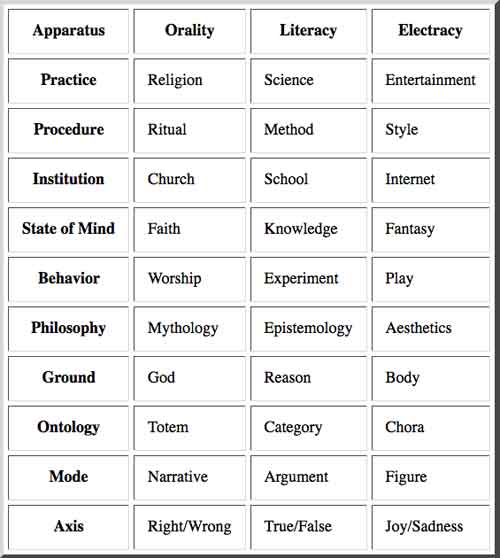
  • A little ontology: Orality, Literacy, and Electracy
  • Maira Kalman
  • What Is/n’t The Kalman Project

A Little History: Technoadherent and Technoskeptics

“I’ve come up with a set of rules that describe our reactions to technologies:

  1. . Anything that is in the world when you’re born is normal and ordinary and is just a natural part of the way the world works.
  2. . Anything that’s invented between when you’re fifteen and thirty-five is new and exciting and revolutionary and you can probably get a career in it.
  3. Anything invented after you’re thirty-five is against the natural order of things.”
  4. Douglas Adams

I’m starting a little bit in left field, I know. What does Kalman’s work have to do with the history of the philosophy of technology? Something, I promise. Bear with me a bit.

Working quick and dirty (in academic terms in sweeping generalizations), I want to sketch two historic attitudes toward technology. Here, technology simply means any invention that changes or augments our ability to do things in the world. Below, I will talk a bit about writing as a technology. But, for now, let’s just think technology in general.

So, two attitudes. I don’t want to call them technophile and technophobe. This isn’t about love or repulsion. Let me rather call them technofaithful and technoskeptic. Faithful and skeptical of what? Of whether technology will act as a force of liberation or domination.

On the one had, there are those that see technology as tied to progression, both in a general “wow life is good” and a Marxist “wow, we can redistribute labor and wealth” sense. Not all technofaithfuls have to believe in both senses. But generally, these folks see technology as freeing humans from some forms of labor, opening time and space for different kinds of work/investments. Furthermore, these folks also see technology as allowing increasing communication, connection, and exposure, allowing us to be more democratic, productive, and ethical, i.e., the more we are exposed to difference (cultural, racial, etc), the better we come at handling the disequilibrium difference causes. Technology allows more free access to information. Technology allows more opportunities for invention, ingenuity, and development.

One the other hand, we’ve got folks like Heidegger who frame technology within a desire for efficiency. Heidegger’s essay “The Question Concerning Technology” believes increasing technological advances has developed in us an unconscious dedication to see everything in the world as “standing reserve,” such that everything, every being (even and especially human being), comes to be “yet to be processed.” Nothing gets to be, to exist, to develop, to flourish, outside of this pressure to be useful, efficient. Technology, for Heidegger and the techno-skeptics that follow his critical tradition, is always already tied to ever increasing forms of homogeny and domination. Rather than opening a more inclusive, public, democratic spaces, technology carves out more exclusionary, private, demogogic spaces (for purposes of this sentence, democratic are places where we encounter and negotiate difference, demagogic are places where we celebrate the same and/as we castigate difference). Rather than distributing wealth and capital, technology allows capital to be more centralized in the hands of the few.

Two attitudes toward technology. What if both are true? What if our existence with technology is always inhabited, permeated by faith and skepticism? What if our experience with technology is caught up between these two pole positions? A tension wire?

If you are wondering what this has to do with our class: video is a technology.

If you are wondering what this has to do with Kalman: I’m not going to tell you. Not yet. Maybe not ever. I haven’t decided yet.

A Little Ontology: Orality, Literacy, and Electracy

Before I (probably don’t) explain what any of this has to do with Kalman we need to take another intellectual detour, to a body of scholarship often referred to as “media affordance theory” or “technology affordance theory” or just plain old “affordance theory.” A few names here: Walter Ong studied how the development in writing in ancient Greece transformed not only *how* the Greeks communicated, but also what they thought reality was (and their corresponding understanding of metaphysics–what/how exists in this world and world(s) beyond the pale of reality’s horizons), what they thought knowledge was, what they thought a human was, how they thought we should govern, and how they thought we should treat each other. The written word, then, influenced not only communication, but ontology, epistemology, subjectivity, politics, morality, and ethics.

To explain how it does all this takes more time than I have here. Suffice to say, the methods we use to think and communicate shape everything we think and communicate. If you think communication is a signifier reaching the ear of another person, then you are likely to think the world in terms of what is immediately present, to see/appreciate the totality of a moment, to judge things in real time. If you think communication as a lone reader deciphering a signifier on a page, then you are likely to think the world (as signifier) in relation to a “distant” (transcendent) signified–whether that signified is a Platonic Ideal, or a Christian God, or an Enlightenment Reason.

Affordance theory came to the fore in the mid-20th century, as theorists from a wide variety of disciplines began to understand that our technological means of communication were changing, growing, incredibly fast. At first, folks thought of radio, telephones, even television as a continuation of literacy. But then, of course we understood them otherwise (Marshall McLuhan’s work is central here). By the time I wrote my dissertation in the early aughts, theorists were speculating about the internet–if, as Ong had demonstrated–writing so radically transformed human experience and culture, what would this new technology do to us, to thought? Gregory Ulmer was one of the most comprehensive writers on the subject.

All of this technological change also occurred within the massive intellectual, political, and aesthetic shift that we call postmodernism. I don’t have time to really explicate postmodernism or poststructuralism here, but I do want to highlight three larger ontological/epistemological/subjective changes it produced.

  • Postmodern theories recognized that human experience and institutions were often underwritten by “metanarratives”–supposedly universal beliefs/expectations/ideologies for how the world works. Postmodernism believed metanarratives were bullshit and harmful to human experience
  • Postmodern theories argued that the desire for universality and objectivity often ended up negating the lives and experiences of people who were not part of the dominant group (white/males). Objectivity wasn’t necessarily something to strive after.
  • Postmodern theories argued that the Platonic/modern/Enlightenment emphasis on Reason and logic repressed pathos and emotion. This was also bullshit and harmful to human experience, since emotion is a natural response that is often rejected by literate/modern/enlightenment philosophy etc

Maira Kalman and What Is/N’t the Kalman Project

Now, if you are smart, you have some sense of why we are reading Kalman in a class on video.

Kalman’s work is not necessarily postmodern. Kalman’s work is certainly not technological in our (or Douglas Adams’) everyday sense of the world. But I think it is electrate.

For the next six weeks, you have a terribly simple but horribly complicated assignment. You have to make me a Kalman that is not a Kalman. That’s it. That’s the assignment. There will (of course) be more parameters and expectations. You will write me a paper (3-5 pages) that explains how you respond to this challenge.

(Note: for those of you who like cheat codes, I have published on this project here and here).

Posted in Uncategorized | Tagged | Comments Off on ENG 229 9.W: Maira Kalman

ENG 301 9: Community Engagement Project

Today’s Plan:

  • Job Fair Information
  • Writing Minor
  • Community Engagement Project

Job Fair Information

I know some of you are seniors, so you might be interested in this.

The Film Studies Program will host a career connections panel with the Colorado Office of Film, Television and Media this Wednesday, October 28th from 12:30-2 pm.

This is a chance to hear from a group of working media professionals (list below), to network, and to hear about how the paths they took in their own careers. This is a wonderful opportunity for anyone who is potentially interested in a career in media, whether you’re an aspiring writer, actor, director, designer, or dreamer (!).

This year we will of course conduct the event virtually. The zoom invite is below. Plan on forty-five minutes of conversation between the panelists and then a half hour opportunity to ask questions directly.

***

Career Connections @ UNC
Colorado Office of Film, Television and Media

Our panelists are:
– Michael Selditch, an independent writer/producer/director who has created and/or showrun numerous documentary and non-scripted television series since 1999
– Shawna Schultz, President and Executive Producer with Mass FX Media, a Denver-based animation/motion design/vfx studio who most recently worked on “The Social Dilemma” for Netflix
– Zhengua “Z” Yang, Founder and Executive Producer with Boulder-Based game development and publishing company Serenity Forge
– Sylvia Gregory, Owner and Casting Director with Sylvia Gregory Casting, which casts talent for SAG Feature and Independent Short Films, video games (including with Colorado-based Deck Nine Games), commercials, web spots, print ads and ad campaigns for numerous national and regional commercials

I have included the Zoom meeting ID and password in today’s email.

Writing Minor

I wanted to share some general information regarding the Writing Minor and the courses we are offering this spring.

Community Engagement Project

This week we start work on our community engagement project. My goal is for us to finish this project by November 24th–that’s only 4 weeks from now! We’ve been moving at a bit slower pace this semester, so we will have to be productive these next few weeks.

Below I outline the deliverables for each team. You can certainly change teams at this point!

  • Grant Writing Team
  • Social Media Team
  • Website ReDesign Team
  • Documentation Team

Grant Writing Team
Deliverables:

  • Grant Recommendation Research Report
  • Grant Application for Green Packaging / Tableware

This week the team will begin researching private-sector funding opportunities here in Colorado. I expect each team member to locate 6 organizations. Those will be compiled into a Google Sheet. Team members will then use the Foundation Center database to research their 6 organizations. [I’ll have more written up here for Thursday’s meeting with the grant writing team]

The grant writing team will share their research in class on November 5th. The grant writing recommendation report will be due Thursday, November 12th. In class on the 12th we will dissect a previous grant application and develop materials for the Green application. We will compare/discuss drafts on Thursday November 19th. Final revisions will be due Tuesday the 24th.

Let’s move to the collaborative workspace.

Social Media Team

Deliverables:

  • Peer Organization Report
  • Social Media Calendar

The Peer Organization report details other non-profit organizations’ social media strategies, with an eye on content. I would like each team member to identify 3 organizations and ” go=”” deep,”=”” spending=”” about=”” an=”” hour=”” with=”” each.=”” you=”” should=”” analyze:<=”” p=””>

We will share the results of this work next week (November 3rd). That will give us 3 weeks to plan and develop content for the social media calendar.

Website Team
Deliverables:

  • Donation Options Recommendation report
  • Peer Organization Websites, Revision Plan
  • Website Revision with Postmortem

The due dates of the website material might change depending on how many people work with this team. I am honestly unsure how many people need to work on the Recommendation Report–it feels like a one person job. Maybe two. Essentially, we need to produce something like this cloud video recommendation report.

The rest of the team can begin working on the Website Revision Memo. For this part of the project, we need two things: first, examples of strong non-profit websites: who/what should we emulate? Second, a more detailed list of the exact things we should address.

We should identify and examine exemplary non-profit sites, paying attention both to content and design. So, to get started, let’s start looking at some exemplary sites.

For next week, each team member should find three sites and apply the rubric below (note–let’s see if there’s things we should add to the rubric, I am doing this off my head):

Here’s some ideas for what we can look for:

  • What kinds of content do the sites have (headings, word counts, different menu tabs, etc)?
  • Mission Statement on the home page (yes or no)? How many words?
  • Donate button? What happens when you click it (pop up, link to another page, do you have to sign up for something? Patreon? etc
  • Where are links to social media (in the header? footer? margins? On their own page?
  • How many colors are on the page?
  • Describe the layout–single column text? multi-column? Large header image a la the “works every time” layout? Text on side next to image?
  • How different is the layout of the homepage to other pages on the site (major change–does size of header image change? Does the actual image change? etc
  • About how much of the screen is text/content and how much is white space/padding?
  • How many fonts on the site? Serif or sans-serif?
  • How many colors on the site?

Documentation Team
Deliverables:

  • Embedded Experience Journal
  • Documentation Interviews
  • Documentation Draft

I need to see who is interested in this group (in both classes) and plan on meeting with them. This is the first time I’ve designed something like this, and I’m struggling a bit to map it out logistically.

For next week, we should transform some of this stuff into practical heuristics for volunteer experiences (the embedded experience journals). We need to know what we need to know.

There is another issue here.

Posted in Uncategorized | Tagged , | Comments Off on ENG 301 9: Community Engagement Project