ENG 201: Week One Questions

I’ve had the opportunity to go through all of your introductions, and I wanted to synthesize answers to your questions in one place. So here we go.

Where and when will this class meet?

Once I get back to Colorado, our schedule will be pretty simple. On Wednesdays, we will meet in the Ross Computer lab. On Mondays and Fridays we will meet in the traditional classroom in Candelaria.

What are we going to learn in this class?

If this course is a bit weird, it is that I don’t often teach you *how* to write. I’ll do a little bit of this–talking about genre, syntax, editing strategies. But this is more a class on what you can do with writing. You’ll take plenty of other classes that emerge you in writing. I assume that, even if you aren’t now, you will all be strong writers by the time you graduate. But English can be a tricky major, in that the work you do in a lot of classes doesn’t directly translate into what people will pay you to do. This class is meant to ease that transition and–especially for freshmen–to give them an idea of where they need to be when they graduate. As I hope the first major project will show, there’s a lot of different possibilities–I just want to make sure you have a sense of that range to inform the choices you make the next few years.

In our first project, we’ll spend a lot of effort analyzing job ads. Along the way, you will learn how to structure and code a qualitative analysis.

Generally, as we look at job ads, I will highlight 4-5 specializations for people with English degrees:

  • Editing (hint: this can mean different things; you probably do not want to be a copy editor)
  • Design/Marketing (someone has to create web ads, write copy for marketing emails, write marketing presentations, design marketing PowerPoints–these jobs pay well and are often looking for English majors)
  • Grant Writers (these are for people who love research and writing; they are highly competitive, but if you can break into this industry, then you are looking at a high paying career)
  • Social Media Managers (pretty self-explanatory)
  • Sales (someone has to make phone calls and write emails to customers, give marketing presentations, manage and grow accounts, etc. English majors end up here more than you might think)

What technologies will we use? Are there technological expectations for this class?

The range of technologies depends on your specific specialization as we move through the course.

  • Folks who want to work on document design will work with Canva, an online, template-driven document design site. This group could also work with Photoshop.
  • Folks who want to work on social media will work primarily with Instagram; this project is less tech-heavy and more about understanding what kind of rhetorical research goes into managing the tech. Because we are developing content for a whole year for Instagram, it is likely that folks in this group will develop ready-to-publish posts in Photoshop. (but photoshop skills are not required to be in this group)
  • There’s the opportunity to work on video-editing, which we would likely do with Adobe Rush (a lightweight video editor); I’d also love someone to design a video intro, which might require the use of Adobe Premiere. I’ll talk more about this possibility later, to see if anyone has video experience and wants to put this kind of project on their resume.
  • The Grant Writing project centers around using the Foundation Center database at Greeley’s Farr library, in addition to a few databases at UNC’s library. This might not sound “sexy high tech,” but knowing how to use these databases really opens you up to grant writing jobs. I need at least 5-6 people to work on this project, and it is my recommendation for the book-loving-technophobes

Essentially, our extensive non-profit community project gives you an opportunity to think about what kind of work you might want to do after graduation and gain some experience doing that work, so you can talk about it on a resume or in a cover letter (or during an interview).

Do I need to buy a/the recommended book(s)?

In terms of the recommended books, you will *eventually* need to purchase one of the following. Don’t do this yet, wait until we talk about it as a class.

  • Grant Writing: Karsh and Fox, The Only Grant Writing Book You Will Ever Need (Recommended)
  • Document Design: Golumbiski and Hagen, White Space is Not Your Enemy (Recommended)
  • Social Media: McCarthy, 500 Social Media Marketing Tips (Recommended)

Your choice should be determined by your interests/career trajectory. Grant writing is best for those who want to be “traditional” professional writers. It is a lucrative career path, and suits anyone who wants to be a researcher/writer.

Document design has benefits in a lot of different areas. It is a useful life skill. It also involves learning fundamental principles of accessibility and visual rhetoric that will carry over into other mediums (like, say, web design, video production, photography, etc).

Social media is probably the most self-explanatory. There’s a bunch of jobs out there today for people who can responsibly handle professional/corporate twitter, facebook, instagram, snapchat, etc accounts. I just got a message that the social media book is unavailable at the book store, but this shouldn’t be an issue. There’s a million of these kinds of books on amazon and virtually any of them will work (in fact, it might be better if everyone on the social media team buys a different book.

I was also going to talk about the possibility of an AP Style editing project, which would involve buying the 2019 AP Style guide.

I’ve done some creative writing in the past, but never published

You need to publish. UNC offers several possibilities for undergraduates to publish fiction and non-fiction, most notably the Crucible literary magazine. Austin Huber is on the editorial board, so talk to him.

More importantly, you should be an active member of the organization. They meet regularly–the website lists Mondays at 5 p.m. in Ross 1155–but I am unsure if that is current. Anyone is welcome to come by and ask how they can help. LISTEN TO ME: basically the only way to get a paying job is to do that job for free until you have enough experience that someone will pay you for it. If you want to be an editor, then this is an opportunity to do that work for free.

I think I want to go to graduate school?

Plan on coming to office hours to talk to me about this. I can help coach you through the process; I reviewed PhD applications at my last job for years. I will also make sure you are aware of the stark realities of the job market for higher education.

Why do you call cats “murder rats?

Here is a kind of explorational thought experiment.

If your dog woke up tomorrow and was the side of a horse, it would probably kill you. In its glorious excitement at seeing you, it would trample you to death. But it would feel really bad about it.

If your cat woke up tomorrow and was the side of a horse, it would straight up murder you without a sign of remorse. It would play with your entrails until it grew bored.

Posted in Uncategorized | Tagged , | Comments Off on ENG 201: Week One Questions

ENG 201 13.R: Job Materials Project

Today’s Plan:

  • Job Materials Project Deliverables
  • Resume Review December 3rd (Canvas: Submit Re-Revised Resume before class)
  • Finding a Job Ad
  • Cover Letters
  • Linkedin

Where to Find a Job

Cover Letters

The ABO entry for “Application Cover Letters” identifies 3-4 purposes for your cover letter:

  • Introduce you as a candidate with the skills that can contribute to the particular organization
  • Explain what particular job interests you (or why you are interested in the advertised position
  • Illustrate via specific examples qualifications in your resume that match the position
  • Signify your desire/availability for an interview (this is a phatic closing gesture)

I wouldn’t necessarily recommend doing things in that order. But you might. It is tricky–you are playing a kind of meta-game with a reader (since the rhetorical purpose of your document is super obvious). The game concerns how skillfully/subtly you can perform within this charged situation. You want to consider tone–how do you come off as someone who is hard-working and professional while also not sounding too formal and/or stiff? (Unless the job advertisement and your online research suggests that they are a formal environment). Essentially, how good are you at reading the room?

Here’s what the cover letter shouldn’t do: it shouldn’t just summarize your resume. It should select one or two skills from the resume and flush them out, providing context and details. Don’t tell me you have experience researching grants, tell me how you partnered with the ARC of Weld County to identify and research, using both the State of Colorado and the Foundation Center databases, 13 specific grants for non-profit organizations focused on children and adults with intellectual and developmental disabilities. Or how you worked with a team of designers to produce flyers for both print and digital distribution for 8 upcoming events. Whatever. The cover letter is your opportunity to tell a story about the best work you’ve done. It is an opportunity to show something (the resume is your opportunity to tell something).

The three examples in the ABO book aren’t bad. But I feel like they could be better. They could provide more details about what someone has done (in some places they feel a bit too much like someone is narrating a resume).

But the ABO advice for the final paragraph is fine. Let’s look at those final paragraphs.

Let’s look at a few sample letters.

Another sample.

Today we are going to be setting up linkedin accounts. Many of you already have a gmail account with your professional/pen name. Good!

First, let’s skim two quick articles on linkedin. Then we will set up accounts.

Linkedin

My expectations for your linkedin account:

  • Education
  • Skills section
  • Location
  • Summary Statement / Elevator Pitch (40-50 words)

What/Why a Web Presence?

For the final component of our Job Materials project, I want you to develop both an online web presence and a portfolio. What do I mean by web presence? What belongs in a portfolio?

No doubt many of you have encountered job advertisements that request writing samples. Those samples can serve a number of purposes: they can demonstrate your awareness/facility with professional genres, your ability to write concise, engaging, and grammatically correct prose, and/or your ability to design clean and contemporary documents. Between now and the time you graduate, you’ll want to assemble a portfolio of works (both print and multimedia/digital) that speak to the range of your talents.

Let’s comb through some relevant readings and carve out answers:

My expectations for your web presence project:

  • An “About Me” or personal description
  • A resume
  • A portfolio of at least four works with some level of textual splash/blurb/description and a relevant image
  • Contact information, including links to professional social media

Google Sites

Given that we have a short amount of time to assemble your portfolios, I am going to recommend using Google Sites. Google Sites is a free CMS/website development program. It is quite easy to use.

What Do I Mean by Graphic

I don’t want to take all day on this, but I could. Let’s look here.

  • A bold image
  • High level of contrast
  • Balance/consideration of thick hyper-legible type with thin body type

We want an image that is striking, arresting, that captures/focuses attention. Powerful, but not busy.

Due Dates

Submit a rough draft of your cover letter to Canvas by Saturday, November 30th at midnight.

Re-submit a resume revision to Canvas by noon, December 3rd

On Thursday, December 5th, complete all work for the Rock Found. We will share in class.

We will not meet during exam week. I will be in my office Thursday, December 13th from 9:00 until 1:00 to review any job application materials.

I will accept revised cover letters and resumes until Friday December 13th. Submit a shareable link, set to “anyone with the link can edit,” that includes your resume and cover letter, to the Canvas assignment “Final Job Materials”

Posted in Uncategorized | Tagged , , , | Comments Off on ENG 201 13.R: Job Materials Project

ENG 229 12.R: Intro Contest Part Deux

Today’s Plan:

  • Release Form
  • Intro Credit Assignment Turn In
  • Intro Credit Audio
  • Intro Credit Expectations

Intro Credit Assignment Turn In

I have created a turn-in on Canvas. You will turn in a shareable link to a folder in my Google Drive. I want everyone to create a folder in the Google Drive (last name-LACopen).That folder needs to contain:

  • A .prproj file that I can open in Premiere 
  • Any logo image files or audio files you use

Because this can be tricky, I would like you to create the folder and submit the shareable link to that folder to the Canvas assignment now.

Intro Credit Audio

We need to settle on some intro audio for these projects. The intro audio clip should be 10 seconds; our introductions are 8 seconds, so this allows two seconds of fade out overlap as we transition into a respondent’s first answer.

We need this music to be copyright-free.

We also have the audio clip that we used last year in the folder above.

Let’s talk about this.

After you identify an audio file, downloaded it. Then clip (crop, trim, etc) the file down to 10 seconds (or so) in Audio Audition or Audacity.

Intro Credit Expectations

So, let’s confirm some things these openings need to do/consider:

  • 7-8 seconds
  • Establishing Shot (montage? single-shot?)
  • Color grading
  • Some kind of title
  • Have template for introducing professor, department, and class
  • Bonus: copyleft music

When you turn this in, it is okay if you don’t have background music or any b-roll. I have included a sample file that you can grab B-roll from if you want to include some to spice up your entry. I will review these (likely on Monday) and have a finalist list that we will vote on Tuesday in class.

Posted in Uncategorized | Tagged , | Comments Off on ENG 229 12.R: Intro Contest Part Deux

ENG 229 12.T: LAC Video Intro Competition

Today’s Plan:

  • Check in on Interview Schedule (Kraver Update)
  • Reminder about Rodriguez talk (Lindou Auditorium, Michener, 6pm, tomorrow)
  • Opening Credits Competition

Interview Schedule

Check in.

Kraver folks: draft email. Shoot for the end of this week or next week. Kraver is available during class time. Ask for questions. Ask who they should contact among recent graduates to interview regarding the importance of CDL designation. Etc.

Opening Credits Competition

I’m going to give you today’s class to work on designing the introductory credits for our Building a Strong Foundation videos. Remember that these are due Wednesday in class.

Some quick tips for designing a logo. While you don’t necessarily have to design a logo, I think these principles are pretty universal.

Here’s a link to the UNCO brand tools where you can find multiple versions of the Bear logo and other branding images.

Here is a link to the UNC style guide which contains official colors and fonts.

Also, if we are using photoshop, then we need to know the difference between a raster image and a vector image. We want these to be vector images.

So, let’s confirm some things these openings need to do/consider:

  • 3-7 seconds
  • Establishing Shot (montage? single-shot?)
  • Color grading
  • Incorporate slogan: Building a Strong Foundation
  • Have template for introducing professor, department, and class
  • Bonus: copyleft music

Have I forgotten anything?

By copyleft music, I mean music that is in the public domain. This could include:

Homework

By next Wednesday’s class, I want everyone to produce a 3-7 second intro sequence–something similar to Clark’s sequence but shorter. This sequence should use some b-roll, contain a Building a Strong Foundation / Liberal Arts Foundation logo, a way of introducing a class and the faculty member. LATER we will add some copyleft background music.

Because some people are lagging behind with their b-roll, I suggest you start by drafting a potential logo and title in Photoshop. Feel free to upload .psd file to the drive. I have a few files in there you can work with.

Submit this assignment as LAF Opening Draft. I’d upload it to Youtube (you can delete it after class).

Posted in Uncategorized | Tagged | Comments Off on ENG 229 12.T: LAC Video Intro Competition

ENG 319 12.T: Democracy and Demagoguery

Today’s Plan:

  • Dema and Demo

Questions

Introduction:

  • What does Miller believe debates about slavery and debates about whether to invade Iraq have in common?
  • What makes demagoguery so tricky?

Chapter 1: Democratic Deliberation

  • How can we explain RM’s skepticism toward “objectivity”?
  • What does RM see as the “real” problem (pg. 12)?
  • What is one significant way to interrupt demagoguery? (see also 48)
  • Who do her discussion of self-skepticism remind you of?
  • Can we all agree her not-definition of sophistry on page 17 rocks? Who does this remind you of?

Chapter 2: How Not to Define Demagoguery

  • What did Plutarch get wrong?
  • Let’s talk eugenics a bit
  • Why does RM describe demagoguery as “comfortable”? (see 65)
  • So, the, what are the right questions to ask? (see 24 and 30 for the wrong questions)

Chapter 3: What is Demagoguery?

  • For each of Miller’s points, which rhetorical theorist comes to mind?

Chapter 4: How Demagoguery Works

  • What is “naive realism”?
  • What are some implications of binary thinking?
  • How does RM describe authoritarianism?
  • What is another “attractive promise” that demagoguery makes?
  • What are deductive arguments? When do they become problematic?
  • What is “charismatic leadership”? Why does it happen?
  • Let’s talk nostalgia
  • What are the dimensions between demagoguery and fear?

Chapter 5: Demagoguery: A Case Study

I want to look at the last paragraph.

Chapter 6: A Culture of Demagoguery

  • Why/How does demagoguery happen?
  • What is a “compliance-situation?”
  • What is (and what is wrong) about an expressive public sphere?
  • Why does demagoguery amplify itself over time?
  • What role does the media play in demagoguery?

Chapter 7: What Do We Do?

  • Let’s finally address the question implicit at the end of chapter 2
Posted in Uncategorized | Tagged , , , , | Comments Off on ENG 319 12.T: Democracy and Demagoguery

ENG 201 11.R: Rock Found Update, Resumes

Today’s Plan:

Making the Hollywood Blockbuster: Screenwriting

Alvaro Rodriguez (Chicago Fire, Machete, Dusk til Dawn Series, Seis Manos, Rust). 6pm. Lindou Auditorium (basement of Michener).

Rock Found Update

WE HAZ EMAIL. And some files.

Professional Presence Project

In addition to our work with the Rock Found, we will spend the rest of the semester working on what I term a professional presence project, which collects all the materials you will need to conduct a successful job search as a professional writer. There’s four deliverables for this project:

  • A resume (consult ABO 484)
  • A cover letter (ABO 36)
  • A website portfolio [Google Sites]
  • A linkedin account

Before Thanksgiving, we’ll spend some time in class looking for actual jobs.

Resume Review

I think one of the hardest things about teaching resumes is that everyone believes they know how to make one–that resumes are easy. I want to begin by suggesting that resumes aren’t easy–and that making a quality resume is quite hard. It is hard for a number of reasons, chief of which is that you cannot know, with any degree of certainty, who or what might read your resume. Rhetoric is the art of adapting a message to a particular audience, of recognizing the affordances and advantages of a particular situation. It always involves elements of risk and chance. I believe job searches are particularly arbitrary–there is no system or pattern to what employers look for because every employer, every human resource director, is different, and brings to the process her own preferences, methods, and attitudes. The best we can do is to learn to analyze, listen, and think through possibilities–to be aware of the potential choices we have and to make precise calculations for every position to which we apply. While we can’t be certain, we can do our best to know our audience(s).

What does this mean in practice?First, the resume has to survive the six second scan. Second, the resume has to be designed for both human and machine processing. Third, the resume has to be tailored to a specific job, it has to foster identification between yourself and the organization/company to which you are applying. You have limited space, every word on a resume has to have a rationale for being there. Today, we’ll use keyword searching and some rhetorical analysis to discover some important words to include.

Further complicating the process–the more instructive materials you read on resumes, the more you are likely to encounter contradicting advice.

Let’s start with the six second scan. Research shows that the average HR director isn’t going to spend 5 minutes combing over your resume. A preliminary scan is likely to be 10 seconds or less. A stack of 100 resumes might need to be reviewed in order to produce a list of 6 candidates for phone interviews. No one has 500 minutes to dedicate to that stack. Increasingly, companies are turning to software to vet first-passes (which is why it is so important to stack keywords into your resume–more on this below).

According to the Time article above, TheLadders has 6 principles for maximizing your chances of surviving the six second scan:

  • Don’t be creative. “So make sure these six items are easily digestible: your name, your current title and company, your previous title and company, your previous position start and end dates, your current position start and end dates, and education.”
  • Put Your Expertise and Skills at the Top. “These are the things that you’ll ultimately be bringing to any new employer, so make sure they’re near the top where a recruiter can easily see them. Use action verbs when describing your accomplishments and back it up with quantitative data when you can. For example, say that you increased sales by 30%, or that decisions you made led to a 150% decrease in operational costs. This is the area where you should feel free to go in depth.”
  • Don’t Make it Too Long. “Some say you don’t want to go past one page, but there’s no real harm in going to two pages – especially if you’re older and have much more experience than a kid just coming out of college. Include as much as you can without making your resume appear cluttered.”
  • Ditch the Photos. “If you only have six seconds, you don’t want them distracted,” Evans says. So get rid of any photos you may have attached to your resume, and don’t try any video gimmicks. It’ll come off as, well, a gimmick. “You don’t want people focused on your face and not your skills,” he says.
  • Don’t Focus on Your Personal Achievements. It’s great that you’ve played the tuba since high school and that you ran a 10K last fall. But don’t spend too much time playing up your more personal info. That sort of light-hearted information is likely to come up in face-to-face interviews anyways.
  • Have it Professionally Made. You might be able to skip the first five steps if you follow this one. “I believe there are three things you don’t want to do on your own,” says Evans. “Don’t do your own taxes, don’t write your own will, and don’t do your own resume.” You may want to write the first draft, but consider taking it to a professional for the final touches. While (not surprisingly) TheLadders has resume writing services, there are many others, including Resumes Planet and Your Resume Partners. These services start as low as around $50 and can go as high as a couple hundred. But for around $100 you can generally get a quality edit and even an entire resume written up for you.

As the last paragraph stresses, TheLadders is attempting to promote a service–and I have some questions about their research. But, in general, these are all fine principles for crafting a resume. But the tricky part is that, depending on the specific job advertisement you have, I can think of occasions when I would recommend breaking all of them. The crafting of a resume is intimately tied to the analysis of a specific job ad–and buttressed by research into the company and or person who might be hiring you. What kind of company is this? Who are they looking to hire? These questions concern identification: understanding the identity of your audience and recognizing how you can mark yourself explicitly (content) and implicitly (form, design) as one of them.

Let’s talk about design. Stay in your lane (know what your skills are and what skills you need to exemplify. Maybe you are this person. Maybe you are this person.

Let’s move on to the second difficulty I outline above: preparing your resume for machine reading, or the ATS (applicant tracking system software, see ABO 500-01). Top Resume offers some nuts and bolts:

  • Stick with .doc or .docx files when uploading a resume rather than a .pdf (and, if it is a .pdf, make sure it is accessible).
  • Don’t use document headers or footers for personal information (including contact information)
  • Simple bullets only
  • Minimalist design with strong visual hierarchy (contrast)
  • Focus on keywords
  • Repeat key words

I want to focus on the final bullets here–keywords–because that crosses us over into analyzing a job ad. First, while I’ve already talked about the importance of concision, I also want to stress the importance of repeating keywords–they might appear in your Objectives section and then again in your Work Experience and then again in your Skills section. Even if you are designing for a human, it is ok to be repetitive with keywords and skills. Redundancy is strategic given the rhetorical situation.

I want to look at this article to talk about format, identifying skills, and quantification.

Thinking about the ABO reading:

  • Be truthful
  • GPA
  • Academic clubs-affiliations (494)

Potential section headings:

  • Heading (name and contact information)
  • Objective Statement (See 496-497)
  • Qualifications Summary (Professional Profile, Key Attributes)
  • Education (Academic Background, Certifications)
  • Employment Experience (Internships, see 498)
  • Related Knowledge / Relevant Skills
  • Honors and Activities (Professional Affiliations, Volunteer Work, Networking Assets, Awards, Recognitions, Notable Contributions, Publications)
  • References (?) Portfolios (We will do this online)

Identifying Keywords, Analyzing Websites, Identifying an Audience

How can we identify keywords? Let’s turn to SquawkFox.

How to frame customer service.

HTML

Think of HTML and CSS in terms of content and form. We use HTML tell a browser about our content, and CSS to tell the browser how to present that content (layout, colors, typography, etc).

We are going to work with bare bones editors in class. Of course, there are powerful programs like Adobe Dreamweaver that make it “easier” to code (because they are doing a lot of the work for you). We aren’t going to go that route, because I want you to learn how to code from the ground up. Learning the fundamental principles of HTML will help you understand how the Internet works and prepares you to learn other languages–CSS, XML, etc. So, to get started, you need to open Notepad++ (if working on a PC) or Komodo Edit or BBEdit on a mac (30 days for free).

The Parts of Speech

HTML languages operate on a simple premise–content gets tagged. Tags open and close. Every piece of content on a page has to have an opening and closing tag. For instance, this paragraph looks like this:

<p>HTML languages operate on a simple premise–content gets tagged. Tags open and close. Every piece of content on a page has to have an opening and closing tag. For instance, this paragraph looks like this:</p>

That illustrates the most basic tag in html, <p> or “paragraph” tag. Don’t read paragraph too literally. The paragraph tag is used for any amount of basic (non-heading, non-listed) text.

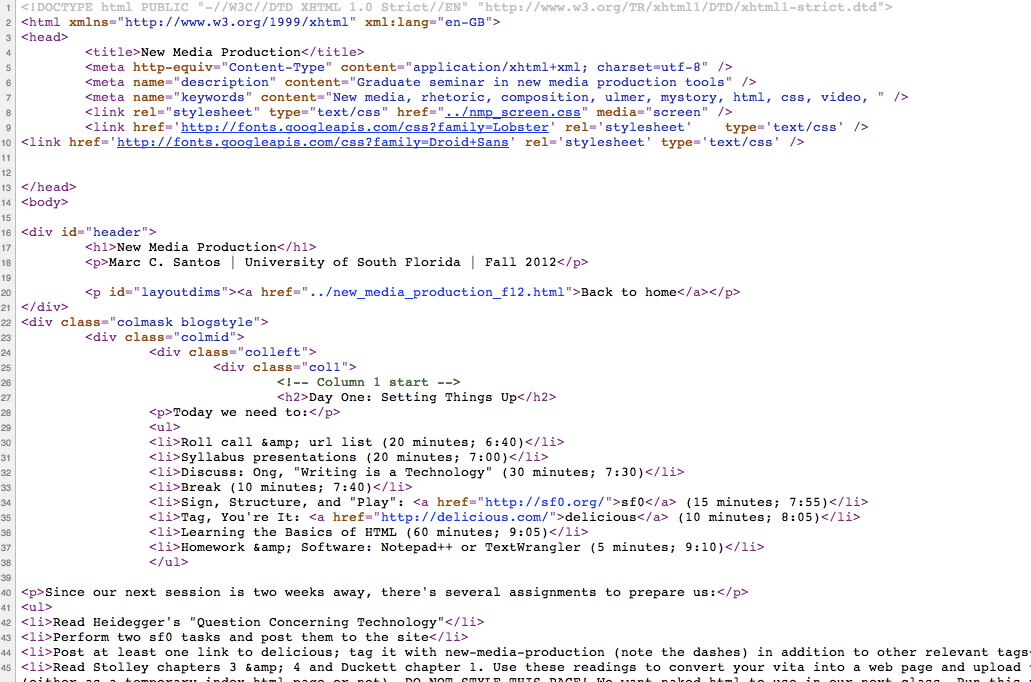
Let’s take a look at what some “naked” HTML looks like in a browser. If, in Chrome, we go to view > developer > view source we’ll see something like this:

code_screen_shot

So, what do we see in that screen capture? Well, we see all of the basic tags. We can think of this as the basic parts of speech for speaking HTML:

  • html & head: in lines 2 and 3, the html and the head tag appear. The html tag contains information for the browser. The head tag opens here. When looking at a web page, you can’t see any part of the head (with the exception of the title field). The head provides information for the browser to process the page. Including:
    • Doctype: The first line in the code is the DOCTYPE. This tells your browser what kind of code it is looking at. Whenever you start a new page, you can copy and paste this DOCTYPE line. For this class, we’ll be coding in the doctype xhtml 1.0 strict.
    • Title: The title tag determines what appears in the tab in your browser
    • Metadata: This is information for search engines (lines 5-7)
    • CSS: Lines 8-10 contain links to the cascading style sheet and google fonts; this is styling information. We’ll deal with CSS in our next class.
  • body: Notice that the head closes in line 13 and the body opens in line 14. The body contains:
    • content tags: all the content in a page basically appears in one of the following tags:
      • p – your basic paragraph tag. Use this for any text information
      • h1, h2, h3 – different headings. The h1 is the page’s main heading, h2 indicates a sub-heading, h3 a more minor heading.
      • ul & li – ul opens an unordered list, li puts an item in that list. Lists are a bit more tricky than paragraphs, but easy once you get the idea. Look at lines 29-38 to get an idea of how a list works (the unordered list opens, all the line items open and close, the unordered list closes)
      • img – check out line 53 for an example of how to insert an image
    • semantic tags – these tags reinforce/augment the meaning of text. It is your basic bold and italics. These tags have to appear within content tags (for an example, look at lines 50 or 55 of this page’s code–first the p opens, then the strong opens, then the content, then the strong closes, then the p closes.
      • em
      • strong
      • cite
      • blockquote
    • structural tags – throughout this page’s code, you’ll notice the following tags. Ignore them for now–they are structural tags that identify content for styling. Essentially, you use structural tags like the div or span tag to target specific content in your CSS sheet. Depending on how the next few weeks go, we might talk about CSS and structural tags later in the course–but for now you can basically ignore them.
      • div
      • class
      • span

I know the above reading is probably not too helpful for those of you just starting to code; so I want you to try and practice coding a document. Let’s jump into Notepad++, open a new document, and start coding. We need to:

  • Open close html
  • Open close the head
  • Open close the body
  • Put a title into the head
  • Put a metadata description in the head
  • Put a metadata keywords in the head
  • Open your sample page, copy/paste all the content in the resume into the body
  • Save the file
  • Preview the file
  • Apply some tags (h1, h2, p)
  • Save preview
  • Apply some more tags (ul li)
  • Save preview
  • Apply some more tags (strong, em)
  • We are not going to build a fracking table today.

Thursday Nov 14: Rock Found Phase #1 Progress Presentations

I am setting aside class on November 14th for each group to present their Phase 1 progress. Presentations should be 7 minutes (not 6 minutes, not 8 minutes, but 7 minutes). Presentations should be rehearsed–concision is important. Presentations should be accompanied by a Google Slides show.

Presentations should summarize what progress you have made (say 5 minutes) and tell us where you see the group going next (2 minutes). This might be harder for the research group–essentially, you should give us some mini-presentations that synthesize research. That is, don’t tell me about one article at a time. Break the articles into topics/ideas/areas of concern and address those across articles. We can talk more about this. Make sure you include presentation preparation work in your memo!

For Next Class

I’m going to make a slight change to the calendar. Because we have Tammy and Cheryl coming to visit next week, I want you to have extra time to work on your presentations. So Tuesday will be a work day–I will leave you alone to complete progress with your group.

But I am going to reclaim the entirety of Tuesday, November 19th to work on your resumes. Note that copies of your resume will not be due until Monday the 18th.

Posted in Uncategorized | Tagged , , , | Comments Off on ENG 201 11.R: Rock Found Update, Resumes

ENG 319 11.R: Surveys, Group Formation, Work Time

Today’s Plan:

  • Surveys
  • Group Formation
  • Work Time

Fundamentals to Surveys

Surveys typically collect three kinds of information:

  • Attitudes and Preferences
  • Opinions and/or Reactions
  • Demographic information

Generally, you measure attitudes and preferences using multiple choice, ranking (favorite to least favorite) or likert scales. While the term likert scale might be unfamiliar, I can almost guarantee you’ve encountered one before.

  • It is very likely you have encountered a Likert scale
  • It is likely you have encountered a Likert scale
  • It is neither likely or unlikely you have encountered a Likert scale
  • It is unlikely you have encountered a Likert scale
  • It is very unlikely you have encountered a Likert scale

Note: social scientists and marketers often omit the middle option above. Doing so forces a respondent to make a decision (the middle option provides them an opt out).

Note: If you do a ranking scale, make sure you tell someone whether 1 is their favorite or 1 is their least favorite.

We can collect more information in surveys via open ended, free write questions. There’s a few issues with these though. One is that people are likely to skip them. If you have more than one of these in a survey, your response rate is likely to plummet. The other difficulty is that these require quite a bit of time to “code”: that is, to go through and synthesize responses. However, that time is usually rewarded.

Collecting demographic information is tricky because (some) people are skeptical of surveys. People can become suspicious if they think they know what your survey is attempting to prove. This can, if they disagree with you, create animosity. This is one reason it is important to create neutral, objective, balanced questions that do not preference a particular response. This skepticism manifests itself in a resistance to supplying demographic information. However, sometimes demographic information is extremely important! So we should spend some time investigating how to ask demographic questions.

There’s more information on question types and some tips in this article.

What Not to Do in a Survey

Some general tips (emphasis–avoid loaded words). Some more tips (emphasis–use audience’s language).

Ok, let’s try an exercise.

A classic example of how not to construct a survey.

Group Formation and Work Time

Here is a link to the Research Hub.

Start with the ETS Document (but think about it across everything we have discussed).

Here is a link to the description of the report due Tuesday the 19th.

Here is a link to the post with our rest-of-year calendar.

For next class

We will be discussing the Roberts-Miller book. I will share some reading questions tomorrow via Canvas.

Schedule

Week 11 (Nov 5, 7)

  • Tuesday: Review second wave of research annotations. Outline course evaluation project.
  • Thursday: Ross Computer Lab. Lecture: Developing Survey Questions. Work: Design / Develop potential course evaluation procedure. Weekend homework: read Roberts-Miller. Complete Canvas assignment.

Week 12 (Nov 12, 14)

  • Tuesday: Discuss Roberts-Miller. Homework: complete
  • Thursday: Ross Computer Lab. Continue to develop course evaluation procedures.

Week 13 (Nov 19, 21)

  • Tuesday: Peer review team assessment materials. Revise materials for Thursday. Organize course eval groups/responses.
  • Thursday: Do course evaluations.

Week 14 (26, 28)

  • Tuesday: Meet to synthesize course evaluation research. Lay out recommendation letter assignments. Thanksgiving break homework: Draft recommendation letter.
  • Thursday: Thanksgiving

Week 15 (Dec 3, 5)

  • Tuesday: Share recommendation letters. Revise recommendation letters.
  • Thursday: Work on letter recommendations.

Week 16 Exam Week (Dec 10, 12)

  • Tuesday: Meet to share recommendation letters.
  • Thursday: No class. Extra Credit assignments are due Saturday at midnight.
Posted in Uncategorized | Tagged , | Comments Off on ENG 319 11.R: Surveys, Group Formation, Work Time

ENG 229 11.R: Sound, Interviews, Kalman

Today’s Plan:

  • 5 Year MA
  • Extra Credit Opportunity: Making the Hollywood Blockbuster
  • Checking in on Interview Responses [11:00-11:15]
  • Sound [11:15-11:25]
  • Lining Up an Interview Take 2 [11:25-11:50]
  • Kalman Comment and Chat [11:50-12:15]

Making the Hollywood Blockbuster: Screenwriting

Alvaro Rodriguez (Chicago Fire, Machete, Dusk til Dawn Series, Seis Manos, Rust). November 13th, 6pm. Lindou Auditorium (basement of Michener).

Checking in on Interview Responses

Let’s keep track of responses in this document.

Here is our current list of interview participants:

  • Prof. Peterson, Phil 100 Trip, Leona, Ben
  • Prof. Finan, ASLS 160 Elijah, Easton, Braeden
  • Prof. Weber, ASLS 160
  • Prof. Romulo, ENST 100 Lauren, Juilanne, Jonathan
  • Prof. Denny, Writing Center Tiffany, Anna, David [Get some B-Roll of the WC’s new sign]
  • Prof. Kraver, 262
  • Prof. Bailey, 225
  • Prof. Kraver and Bailey, Revised EED Major Abby, Katherine, Keelie, Sofia, Sydney
  • Prof. DeWitt Carl, Austin, Gideon

Sound

Let’s try an experiment to get a sense of audio quality.

Let’s try an example now and upload the audio and video files to our collective google drive.

Now let’s try a sync. Here is a video tutorial that has a really quick way and a really precise way to sync audio.

If we have time left in class today, I’d also like to work on adjusting the audio volume of sound again.

Here is the drive to upload our sample(s).

Kalman

I’ve got an activity planned for Canvas.

For Next Class

On Thursday, the 21st, I will reward credit for progress on the Kalman project. I will ask you to share whatever raw footage you have collected by that point. There is no scheduled homework between now and Thanksgiving save to conduct your interview/capture B-Roll and work on the Kalman project.

Next week’s class sessions will be dedicated to creating an opening credits for our new video. We will all use the same stock footage as a sample (video collected last year).

Posted in Uncategorized | Tagged , , | Comments Off on ENG 229 11.R: Sound, Interviews, Kalman

ENG 319 11.T: How Can We Improve Course Evaluations?

Today’s Plan:

  • Review your Research
  • Course Evaluation Project Details
  • For Next Class

Course Evaluation Project

On Thursday we will meet in the Ross Computer lab. I will ask folks to form groups and begin designing better course evaluation methods. This part of the project will be due on Tuesday, November 19th. There are two main deliverables for this part of the project.

  • A new course evaluation survey (both a Google Doc and developed in Google Forms)
  • A Course Evaluation Improvement Recommendation Report

The report should have the following sections:

  • Introduction (250 of the best words you have ever written; don’t even fucking try to write this until you have finished the rest of the report. SERIOUSLY I will know)
  • Background Research: Identifying the Problems with Course Evaluations (300-500 words)
  • Developing a New Survey Instrument (600-800 words that explain how you put together a new survey and why those questions are necessary/important. Note–that word count might be too low. Not sure.)
  • Beyond Surveys (600-800 words on what and why, in addition to the traditional survey, the department should incorporate into its evaluation criteria / instructor evaluation procedures

This is a business report, not an academic paper, so we will use business formatting (single-space, block paragraphs). We will use APA citation with a reference list. The Google Doc version of your Course Evaluation will be included as an Appendix.

Review Your Research

I’d like to pick up where we left off Thursday. Tell me what you know.

For Next Class

You need to read the entirety of the Miller Demagoguery book for next Tuesday. Sometime on Friday I will put up a reading notes / response “quiz” on Canvas. But our class discussion on Tuesday will be directed toward specific sentences in the text. Underline the sentences that sting you.

Posted in Uncategorized | Tagged , | Comments Off on ENG 319 11.T: How Can We Improve Course Evaluations?

ENG 229 11.T: Organizing Our Interviews, Working with Sound

Today’s Plan:

  • Organizing the LAC Interview
  • Shooting an Interview
  • Working with Sound

Organizing the LAC Interviews

First, we need to break into groups.

Here is our current list of interview participants:

  • Prof. Peterson, Phil 100 Trip, Leona, Ben
  • Prof. Finan, ASLS 160 Elijah, Easton, Braeden
  • Prof. Weber, ASLS 160
  • Prof. Romulo, ENST 100 Lauren, Juilanne, Jonathan
  • Prof. Denny, Writing Center Tiffany, Anna, David
  • Prof. Kraver, 262
  • Prof. Bailey, 225
  • Prof. Kraver and Bailey, Revised EED Major Abby, Katherine, Keelie, Sofia, Sydney
  • Prof. DeWitt Carl, Austin (Pending), Gideon

Here is a link to a workspace.

Shooting an Interview

Let’s review some interview basics (especially “repeat the question”).

Let’s quickly gloss some resources on camera angles and framing shots:

Upload your framed shot to this Slideshow.

Working With Sound

Because we are interviewing faculty for this project, I’m going to decide against using a lavalier mic, if only because using one can be awkward. But when you shoot your interviews, I am going to ask for you to use two smartphones. The first will be used to capture video (duh), the second should be used to capture audio. Place this second phone as close to the subject as you can while keeping it out of the shot. Be sure to use a “clap” to aid in syncing up audio later.

Let’s try an example now and upload the audio and video files to our collective google drive.

Now let’s try a sync. Here is a video tutorial that has a really quick way and a really precise way to sync audio.

If we have time left in class today, I’d also like to work on adjusting the audio volume of sound again.

Posted in Uncategorized | Tagged , | Comments Off on ENG 229 11.T: Organizing Our Interviews, Working with Sound