ENG 122 7.M: First Sentences, Thesis Statements, Williams on Characters

Today’s Plan:

  • Reminder: No class this Friday
  • First sentences, thesis statements
  • Williams on Characters
  • Homework

First Sentences and Thesis Statements

Overall I wanted to highlight the improvement I’m seeing from the first set of papers. I’m seeing some impressive stuff! Let’s take a look.

Williams on Characters

Last week we worked with chapter 3 of the Williams on Actions. I want to review that work and take a look at his fourth chapter on Characters.

  • Back to the Canvas Quiz
  • Exercises from the handout

Homework

Revise your second medium.com article. I’m still working on providing feedback to this set. You will be posting this set of articles to Canvas on Friday.

For next Monday’s class I want you to print and read Jim Corder’s article “Argument as Emergence, Rhetoric as Love.” A .pdf of the article will be available in Canvas.

Posted in teaching | Tagged , | Comments Off on ENG 122 7.M: First Sentences, Thesis Statements, Williams on Characters

ENG 122 6.F: Peer Review Article #2

Today’s Plan:

  • Paragraphs are about ideas
  • Looking for Active Verbs
  • Homework

Topic Sentences for Paragraphs

Let’s look at this one.

Let’s look at this one.

Let’s look at this one.

Let’s look at this one.

Let’s look at one more.

Homework

Revise your draft based on peer feedback. Check the topic sentences to your paragraphs–are they about ideas?

Input your second article into the Writing Groups Google Doc.

In Monday’s class we are going to work more with Williams’ work on characters and actions.

Posted in Uncategorized | Tagged | Comments Off on ENG 122 6.F: Peer Review Article #2

ENG 201 6.R: Grant Project, Calendar Redux, Photoshop

Today’s Plan:

  • Grant Project Update
  • Calendar Redux
  • Photoshop Fundamentals

Grant Project Update and Calendar Redux

Today I sat down and invested a few hours into the grant project. As a result, I’ve made some pretty heavy changes to the calendar. Here’s how I see the next month and a half playing out:

  • Week 7 Oct 2 & 4: Finish Project 2. Produce a final project memo (I will provide the details for this memo on Tuesday the 2nd. Remember we have no class on Thursday the 4th)
  • Week 8 Oct 9 & 11: On the 9th I will introduce the new third project. In place of a documentation project, we are going to do a recommendation report. Groups of 3-4 will research 4-6 potential grants in order to identify which ones would be most useful for our client. Reports will look into past award winners, application materials, organizational history and mission, and whatever else we can come up with. Between now and October 9th I’d like you to read Karsh and Fox Lessons 2 and 3 (“What is a Grant” and “What Do Grantmakers Want?”). We’ll use that reading on the 9th to inform the recommendation report.
  • Week 9 Oct 16 & 18: Keep trucking on that report. Officer Reis will be visiting us either this week or next week. Turn the report into a presentation
  • Week 10 Oct 23 & 25: Research for the grant. Begin Drafting.
  • Week 11 Oct 30 & Nov 1: Complete drafting. Peer review.
  • Week 12 Nov 6 & 8: Revise and complete grant application.

We’ll spend weeks 13, 14, 15, and 16 focusing on the job materials project–putting together a resume and cover letter for a specific job, developing an online portfolio of written/multimodal work, and establishing a professional online network (via twitter, linkedin, etc).

Photoshop

I’ve sent out a .zip file with a few little activities.

  • Modify an Image > Brightness
  • Modify an Image > Color to Black and White
  • Spot Healing Brush
  • Quick Select and Content Aware Fill
  • Combining Images

If we have time remaining, we can try out a cool tutorial.

Posted in Uncategorized | Tagged , | Comments Off on ENG 201 6.R: Grant Project, Calendar Redux, Photoshop

ENG 122 6.W: Questions and Drafting Time

Today’s Plan:

  • Questions
  • Drafting Time
  • Homework

Questions

Round 2.

I have trouble writing a clear thesis statement. Any ways I can get better at it? AND What is the biggest difference between an A and a B on an essay?

Thinking back to last class, I have two strategies. The first is to look at your conclusion. Chances are, having just drafted your paper, you have a clearer idea of what you actually wrote. You can’t write a clear thesis until the paper is “finished.”

The second is to “road map” the paper. This isn’t exactly the thesis (which is a claim), it is the steps the paper needs to take to do that claim. Something like:

This paper argues that the Dolphins +7 is a smart bet this week because their secondary matches up well against the Patriots and their quarterback has the kind of mobility that gives the Pats troubel. First this paper examines Vegas lines for the upcoming Patriots vs. Dolphins game, noting how the line has moved in favor of the Patriots as the week has gone on. It then surveys various expert predictions of the game which stress the issues with the Patriots secondary and pass rush this season, the efficiency of the Dolphins offense, and the stellar play of Dolphins cornerback Xavien Howard. It concludes by looking back to last year’s December 12th contest between the Patriots and the Dolphins, noting how the Dolphins had trouble pressuring Jay Cutler and the Patriots had trouble protecting Tom Brady. While many experts find it hard to predict the Patriots going 1-3, I believe that mystical thinking is why the Patriots are 7 point favorites. Looking at how both teams have played thus far, I cannot find any reason to believe the Patriots are the favorite to win this game, never mind a -300 favorite.

So, a third strategy: make sure your thesis gives specific things–that’s one of the things that distinguish an A from a B. The other is the quality of your reading and engagement with a source. There’s a difference between a “drive-by citation,” where it feels like you are just dropping in a quote or reference in order to check a box and an authentic engagement with someone else’s idea, where you’ve done the work to present their idea, surveyed their evidence, and given a response (be it additive–this is a good idea and it reminds me OR Smith’s idea can help us understand OR I would add to Smith the fact that OR While I appreciate Smith’s effort here I feel she overlooks OR any other kind of They Say, I Say template.

Are we able to write on topics that have already been addressed by someone else in our writing groups?<

Ab-so-lutely! Respond to them. Thank them. Challenge them. Cite them. Link to them. Treat them like any our source!

Do we (should we) go through every sentence and re-write them? AND I’m confused on how to make a good sentence with the subject and the verb, those confuse me? AND struggled with Canvas quiz, no sure if I did it right

Short answer: probably. Longer answer: re-reading your work is a part of the revision process. Think about it this way: the first draft, the one you will finish for Friday’s class, is the rough draft. That’s about getting some ideas out there. The second draft is where you want to refine those ideas. Think about how they are ordered. That’s the draft you send me, so I can focus on helping you further develop and clarify those ideas. The third draft–the one you post to medium–should be where you give attention to copy editing, style, and voice. That’s where you should go through the paper and identify the subject and the verb for every sentence. We’ll practice this in class on Monday–the characters as subjects and actions as verbs thing can take time to internalize. Some folks get it right away, others don’t. Don’t worry if you still aren’t sure about it, we’ll keep working on it

Will you tell us if we need extra help for this class?

So I’ve read at least one sample of everyone’s work and I don’t think there’s anyone here who necessarily needs the supplemental class (there is an optional, one credit, extra help class for ENG 122). I mentioned that class early in the semester. The instructor, Sonya Scullion, is really cool. Email her: sonja.scullion@unco.edu. It is a late enroll class, so you can still decide to join.

Ultimately, you probably have a better feel for how you are doing. I have to try and decide whether I am getting your best effort–are you putting in an hour a night? Are you spending 4 hours on a rough draft? Or are you trying to rip off a draft in an hour or two the night before they are due? I can’t always figure that out.

I’m also not a mind reader. I can’t always tell who is really struggling. If you need help, COME TO OFFICE HOURS. Seriously, I can probably do more in five minutes working one-on-one than I can do in five whole class sessions. Bring whatever you are working on. Come and say “I have no clue what to write about.” Come and tell me you have no idea what a verb is because you never got taught that in high school. I can do my job better when I know what I should do. And if you have a question, then so does someone else.

Homework

Friday: bring two print copies of your second article to class for peer review.

Posted in Uncategorized | Tagged , | Comments Off on ENG 122 6.W: Questions and Drafting Time

ENG 201 6.T: Project 2 Check In, Corder

Today’s Plan:

  • Project 2 Check In
  • Corder
  • Homework

Project 2 Check In

I didn’t have time to create a customizable Canvas turn-in for everyone, so here’s the plan. I have edited the second major assignment to be Project Two: Developing a New Proficiency. I’d like you to put together a Google Doc that serves as a kind of portfolio for your work, one in which you document what you’ve been working on and upload/link to/embed evidence of your progress.

You can date entries in the Google Doc according to your progress on your proposal/ghantt chart. If your proposal wasn’t that detailed, then date entries by major accomplishments.

As of the time I am writing this, two people have emailed me a second update: Jason and Erika. J & E: Don’t worry about re-submitting or re-documenting the work laid out in those emails. I’ve responded to them today. But from now on, just use the Google Doc to keep me informed of your progress.

Everyone else: your homework between now and Thursday is to create a Google Doc and submit a shareable link in Canvas. Make sure the link is set to “Anyone with the link can edit.” Don’t share the link with my UNCO email address–it won’t work. Don’t fret about this–if you are unsure how to create a shareable link, then I can show you in class on Thursday. But my help will probably look like this, so…

Corder

Before we get started, I want you to think about the last three times you really disagreed with someone on anything significant. Any level of significance. Not like “where should we eat dinner.” But something at which something was at stake. Take a few minutes and think about it. Jot down some quick answers to the following questions (if you have a few clear ideas, then maybe make a grid).

  • How long did it take you to think of a few things?
  • Are you friends with the person? Relatives? Or are they outside your normal circle?
  • Did the disagreement happen face-to-face? Online?
  • Looking back, would you change your position? If you talked about the disagreement again, do you think they might change theirs?
  • When was the last time you really believed something and then changed your mind and believed something else?

Corder Summaries

In groups I’d like you to discuss the following questions:

  • Group One: [sections 1-3]: What does Corder mean by the idea that we make narratives? Why do said narratives complicate traditional notions of argument and rhetoric?
  • Group Two: [sections 4-6]: How can we describe Rogerian method? Why is Corder skeptical that such a method can be useful to rhetoric?
  • Group Three: [sections 7-8]: Looking at section 7, would your frame Corder as an optimist or pessimist? What do “we” have to learn (and who are the “we” of this section’s final paragraphs)? What do we make of section 8? Why is this anecdote here? What does it exemplify or reinforce?

Jim Corder, “Argument as Emergence, Rhetoric as Love” as the Grounds for a Rhetoric Other than Persuasion

I think somewhere in the end of last class I announced that Corder’s essay is one of my favorite essays ever. It is. It had an incredible impact on my career. At this point I cannot even remember when in graduate school I read it for the first time. But just about everything I’ve written since–and especially anything having to do with the purpose, study, or teaching of rhetoric is haunted by it. My dissertation focused on the ethics of Emmanuel Levinas, but my reading of Levinas (and other theorists such as Alphonso Lingis, Julia Kristeva, and Adriana Cavarero) is likely overdetermined by my investment in this essay and the questions it raises. I say questions because I think in many ways it raises more questions than it answers.

In order to understand what questions it raises, I want to establish three important elements of rhetoric.

First, I want to mention Kenneth Burke’s essay on “Terministic Screens,” particularly, Burke’s idea that terms often capture “attitudes.” Terms can think for us, though this thinking isn’t necessarily in the conscious mind, but in the subconscious one. To attend to rhetoric is to bring the subconscious elements to the surface, to call attention to the ways in which language thinks for us, affects us, even when we might not be aware of it. That is, rhetoric disrupts our normal communicative economy (information) by asking questions about exchange rates (affect).

Second, again recalling Burke, language does more than simply convey information. Language acts. Language is symbolic action. As Burke writes in Permanence and Change, “words are fists.” Or, at least, they can be. They can strike us. They can disarm us. But they can do more than that. The point to remember here is that language is never simply transmitting knowledge (logos). Language always hits a target–again, it is affective, or pathetic. There is no utterance that does not touch upon our emotions. Philosophy, in the tradition of Plato, has long defined itself as a discipline that filters emotion out. Emotion is noise that gets in the way of the Truth (logos). Rhetoric thinks emotion (pathos) otherwise.

Third, rhetoric approaches all language as political, in the sophistic sense of the term we traced out via Gorgias, Isocrates, Jarratt, McComiskey, and especially Lanham earlier in the course, whether you call it nomos, social construction, or the strong defense. Words are fists, and, as the theorists Francois Lyotard reminds us, “to speak is to fight.” All those hits pile up. There is no utterance that does not hit upon another and, at the very least, make a demand of her time and attention. Such demands are taxing, and part of any rhetoric dedicated to the political (in either the broader sense of the social I have traced here or even its more common everyday sense of civic deliberation and government) has to account for the difficulty we face just trying to pay attention.

Part of this difficulty is amplified by our innate allergy to alterity, to difference. This, I believe, is the incredibly important conclusion articulated by Corder. Victor Vitanza, in his attempt to fuse ancient sophistry with contemporary philosophy (particularly Nietzsche and Derrida), writes:

My position is […] that we are not at home in our world/whirl of language. Any and every attempt to assume that we are has or will have created for human beings dangerous situations. (Negation, Subjectivity, and the History of Rhetoric, 157).

The desire to end the whirl, to find ourselves standing on solid, unquestionable ground, explains for me why people will often ignore research and evidence that contradicts an ideological narrative. It explains why pizza owners in Indiana won’t serve LGBTQ weddings, and why Americans will donate nearly a million dollar to said owners in support. In the social sciences, such a tendency is termed “confirmation bias.” To anticipate my conclusion, I want to suggest that addressing confirmation bias requires more than addressing means of interpretation. It requires we craft a subject with the emotional capacity requisite to develop “a will to interpret otherwise.”

And this, for me, marks off the province of 21st century rhetoric and the scope of Corder’s questions. We are aware of all these things: language’s ability to subconsciously strike at any notion of difference or otherness, and our human–all too human–desire for Perfection. Simplicity. Unity. Certainty. Truth. These terms are not innocent. We must learn to hear them. In the age of digital cacophony, rhetoric is the discipline that cultivates civic subjects willing to listen. To attend to difference. To eschew the safe and the simple for something more messy, complicated, and–ultimately–ethical.

Corder arms us with a better recognition of how and why arguments get heated. Because arguments aren’t something people have. Arguments are what we are. I stand here as an argument for how a human should be. My being is my argument for itself. My comfort with myself, as a being, is rooted in being comfortable with myself. I might rely on external elements to support the righteous of my being. The Bible. The Constitution. Plato. Nietzsche. Plath. Seinfeld. Simpsons. Whatever. But, ultimately, I would argue that no matter the depth of our faith in the righteousness of such external elements we are haunted–as Vitanza puts it–by a (sub)conscious knowledge that such elements are not, in the words of Derrida, “assured.” And when someone approaches who doesn’t fit into the shape of the external–their square won’t fit in my circular hole–they produce an agitation at the core of my being. Their very existence is a challenge to my fundamental ontology. The are “other.” Of course, Corder doesn’t use this kind of language–but this is how I understand his argument that we are arguments. His question, as I understand it, is to ask how we can better train people to repress the urge to slay the other for the fact of her otherness. His answer is to provide “time.” One has to wonder if the acceleration of the digital–the way it spends up communication and thought– has contributed to the toxic political environment in which we now dwell. How can we slow down? These are the questions I attribute to Corder. These are the questions that my own scholarship has attempted to answer. I don’t think I’ve done a great job.

But scholarship isn’t always about solving a problem. Often it is about exploring a problem, recognizing it. More often, it is simply about getting others to see your problem, to pull them to it. To give your problem gravity. Bruno Latour argues something is real only in so much that it impacts others–that we can trace connections and effects. Scholarship, then, can be seen as the attempt to collect and assemble more actants in your problem’s network.

This semester, then, has been my attempt to recruit you to my cause–even if temporarily. To the question of how, or if, but certainly why, we need to learn to practice listening as I have worked to describe it. Listening, not in terms of waiting to speak, waiting to persuade, respond, counter-argument. Not in the Platonic/Aristotelian tradition of agonism and dialectic: we aren’t necessarily listening to change the other. Rather listening in terms of what Corder prioritizes–as taking the time to reflect inwardly before lashing outwardly. Learning to listen with a willingness to change ourselves.

In short, we must learn to hear our own desire for perfection, simplicity, unity, certainty, truth. And we must educate ourselves such that we don’t allow these desires to dominate the way we interact with others. Rhetoric is particularly suited to such a task, since its historical mission has been to conceptualize and predict the ways in which different audiences might interpret a particular message.

I am not an Idealist here. Conceptualizing rhetoric as listening isn’t a utopian proposal. It is not a means to ending the interminable wrangle of the marketplace. This does not mean we live in a world without argument or debate. This doesn’t mean we cannot criticize others. But it does mean that we must take the time to listen to other positions, to resist the immediate impulse to attack and tear down, to try to identify possible starting places for cooperation. There will be times when there are none. There will be times when our opponents steadfastly refuse to extend us an ear. We will be tempted to stop listening.

I will not pretend that I offer a solution for how to “fix” these impasses. But I will say, quite frankly, that I worry for the future of our government, our fragile democracy, when I see a generation of politicians, and Americans, who seem so disinclined to attend to other opinions. Other narratives. Other possibilities. It is our task, as rhetoricians, to open this problem, to broadcast it, to insist upon better media, better politicians, better schools, that acknowledge the necessity of listening, of encountering difference, rather than obfuscating, synthesizing, silencing, or ignoring it.

My dedication to thinking rhetoric as listening, and to think of listening in terms of ethics stems from my firm belief in the failure of the Enlightenment ideal (particularly the one introduced to us by Kant): the commitment that knowledge, and the gradual progression of knowledge, is sufficient to solve our human (and, of course, non-human) problems. I do not believe this to be so. For it does not address the most obvious question: how do we persuade someone to listen to knowledge? How do we cultivate a citizen, a self, willing to listen, to consider, to change? Those are not rhetorical questions, but rather the questions that drive my dedication to rhetoric.

One other thought: an anecdote from the last time I taught Corder that still troubles me (tied to Corder’s idea that “any statement carries its history with it” (17).

Homework

As above, continue to follow your proposal and craft me some kind of memo in Google docs that tracks your progress.

Also, read the file Abras et al on User Centered Design (you’ll find a user-centered-design file in Canvas) for next Tuesday.

We will be meeting Thursday in the computer lab to work with Photoshop.

Posted in teaching | Tagged , , | Comments Off on ENG 201 6.T: Project 2 Check In, Corder

ENG 122 6.M: Thesis Statements, Roadmapping, Characters and Actions

Today’s Plan:

  • Office Hours
  • Drop Deadline [Thurs Oct 11]
  • Thesis Statements and Roadmapping
  • Williams on Actions (and characters)
  • Questions
  • Homework

Office Hours & Drop Deadline

Wednesday: 1:30-3:00, Thursday 1:00-2:00.

Thesis Statements and Roadmapping

I am always hesitant to use the term “thesis statement.”

As writers–especially academic writers–we have an obligation to let our reader know what they are committing to right up front. Some of this work falls under the heading of kairos, a Greek term for recognizing and seizing the most strategic moment for speech and action. We’ll talk more about kairos later in the course.

Why am I hesitant to use the term “thesis statement”?First, they come with a lot of baggage from high school. Some people do a terrible job explaining what a thesis is and/or have loaded the term with dread. Second, good papers often don’t have “a” thesis statement (i.e., articulating the thesis, or central argument, of the paper might require more than one sentence). For me, the thesis of a paper is an explanation of the article’s purpose or argument, along with a road map for how the author hopes to get there: what steps will she take? The first is an absolute requirement. The second isn’t necessarily as popular in public writing, but is pretty essential to good academic writing. In public writing, it is ok to have a bit of a Scooby Doo thesis–one that doesn’t necessarily reveal everything right up front. In academic writing, this is almost never ok.

Ok, let’s look at how I do this. Here is what I would call the thesis for an article I co-authored called “Postpedagogy and Web Writing” (an article about how and why I teach this class in the “peculiar” way I do):

This article is divided into two major sections. The first section further explicates the concept of postpedagogy, highlighting its suitability to web writing. In short, postpedagogy advocates a critical and self-reflexive re-inhabiting of teacher authority and an insistence on kairotic, emergent, “risky” learning. The second section details how we have enacted such a model, in a variety of first-year and upper-division courses over the past six years. Taken together, the two sections demonstrate how writing for an English class and writing for the real world no longer have to be two separate enterprises. That boundary is now a matter of choice, rather than one of logistical necessity.

This paragraph comes a few pages in, well after we have laid out the purpose for the article (we do that in the first paragraph). It is meant to give a reader a sense of what is coming, a “road map” for the turns the article will make.

Here’s another example from a book chapter on Bruno Latour’s plan for reconnecting academics to politics:

This chapter begins by briefly unpacking Latour’s Non-Modern Constitution, tracing its development through his earlier writings to its explication in Politics of Nature. We then review two of Kant’s critical pieces on the role and scope of higher education, his early essay “An answer to the question ‘What is enlightenment?’” (1996) and his later, and more controversial manuscript, Conflict of the faculties (1979). Our analysis contextualizes Kant’s call for the separation of public and private duty in light of the snarly religious/political field of late 18th century Germany. Then, we detail contemporary politics’ increasing encroachment upon curriculum and funding across all levels of education. While contemporary scholars might not face the same “unpleasant measures” that Kant did, there are clear risks associated with reintegrating academic labor into the public sphere. However, despite these risks, academics must commit themselves to political action. Academics cannot remain idle; they must act before it is too late. We close by offering strategies and tactics (de Certeau, 1984) for instituting Latour’s Non-Modern Constitution. As a strategy, we present the University of South Florida’s recently approved Patel College of Global Sustainability, an interdisciplinary college dedicated to increasing scientific knowledge’s impact in the public sphere.

Sometimes I write papers that take a bit more space to do this.

Sometimes I write introductions that do this without explicitly laying out the sections.

My point is that good writers let the audience know what’s coming.

But here’s the thing, it is impossible to write this kind of introduction on your first draft. No one ever sits down and says I will write a paper that does X, Y, and Z and then actually writes that paper. Why? Because writing is emergent, generative, spontaneous, unpredictable, and often out of our control. As the Helen Cixous says–writing writes us as much as we write it. You can’t write the kind of introduction I lay out above until after you write the paper–until after thoughts that you initially couldn’t anticipate have thrust themselves upon you–often uninvited. Writing will productively trouble you by asking questions you weren’t prepared for. This means that the introduction MUST be the last thing you write.

“No way” at least one of you will say. I can’t start writing without writing an introduction! I agree. You probably can’t. You have to write that first introduction to get the thought-train moving out of the station. To plant your feet on some solid ground before the writing begins and the thoughts try to hijack it. But that first introduction you write is a baby. And what do we do to babies?

Williams on Actions (and characters)

Let’s talk about the homework.

Homework

There’s two Constant Writing assignments in Canvas:

  • Monday, Sept 24th
  • Tuesday, Sept 25th

For the Tuesday article, I want you to concentrate on comparing/contrasting the second article with the first. Don’t treat them in isolation–work to find two articles on the same subject and read them close enough to identify what they have in common and where they disagree.

Review chapter four, “Three Ways to Respond” in They Say, I Say. Transform one of the templates in that chapter to put your two sources in conversation. (There’s different perspectives regarding X. Person A believes X will Z, but person B disagrees because N. She believes position A/X overlooks C and D.

Posted in teaching | Tagged , , , , | Comments Off on ENG 122 6.M: Thesis Statements, Roadmapping, Characters and Actions

ENG 201 5.R: Introduction to HTML

Today’s Plan:

  • Intro to HTML
  • Homework

Intro to HTML

My goal for the next two weeks is to teach you HTML coding. If we have time, we might learn some elementary CSS. Think of HTML and CSS in terms of content and form. We use HTML tell a browser about our content, and CSS to tell the browser how to present that content (layout, colors, typography, etc).

We are going to work with bare bones editors in class. Of course, there are powerful programs like Adobe Dreamweaver that make it “easier” to code (because they are doing a lot of the work for you). We aren’t going to go that route, because I want you to learn how to code from the ground up. Learning the fundamental principles of HTML will help you understand how the Internet works and prepares you to learn other languages–CSS, XML, etc. So, to get started, you need to open Notepad++ (if working on a PC) or Komodo Edit or BBEdit on a mac (30 days for free).

The Parts of Speech

HTML languages operate on a simple premise–content gets tagged. Tags open and close. Every piece of content on a page has to have an opening and closing tag. For instance, this paragraph looks like this:

<p>HTML languages operate on a simple premise–content gets tagged. Tags open and close. Every piece of content on a page has to have an opening and closing tag. For instance, this paragraph looks like this:</p>

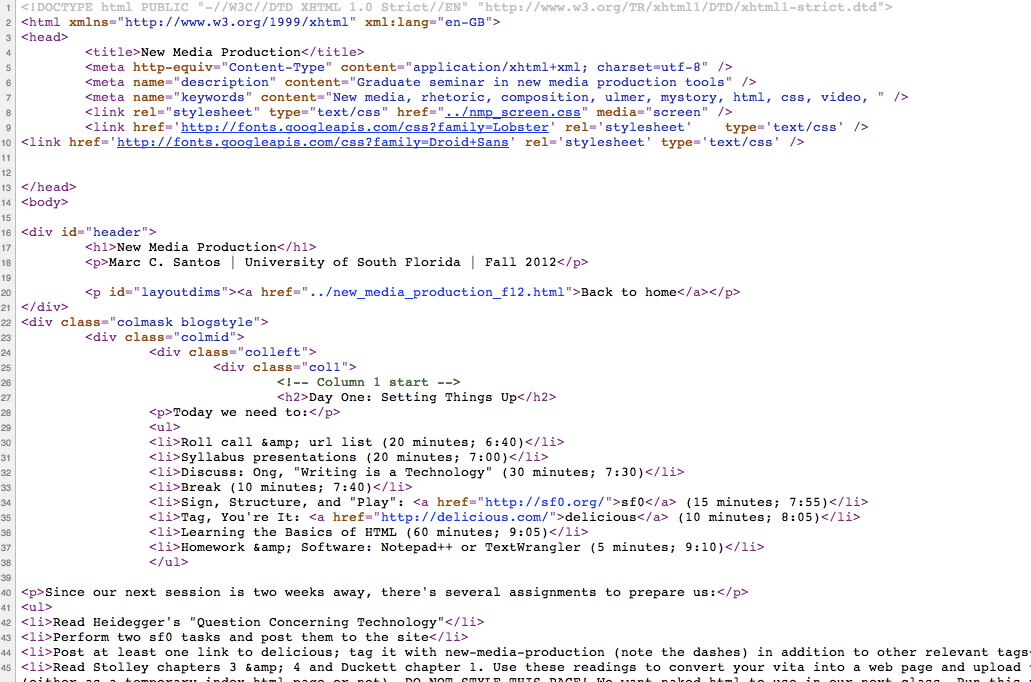
Let’s take a look at what some “naked” HTML looks like in a browser. If, in Chrome, we go to view > developer > view source we’ll see something like this:

code_screen_shot

So, what do we see in that screen capture? Well, we see all of the basic tags. We can think of this as the basic parts of speech for speaking HTML:

  • html & head: in lines 2 and 3, the html and the head tag appear. The html tag contains information for the browser. The head tag opens here. When looking at a web page, you can’t see any part of the head (with the exception of the title field). The head provides information for the browser to process the page. Including:
    • Doctype: The first line in the code is the DOCTYPE. This tells your browser what kind of code it is looking at. Whenever you start a new page, you can copy and paste this DOCTYPE line. For this class, we’ll be coding in the doctype xhtml 1.0 strict.
    • Title: The title tag determines what appears in the tab in your browser
    • Metadata: This is information for search engines (lines 5-7)
    • CSS: Lines 8-10 contain links to the cascading style sheet and google fonts; this is styling information. We’ll deal with CSS in our next class.
  • body: Notice that the head closes in line 13 and the body opens in line 14. The body contains:
    • content tags: all the content in a page basically appears in one of the following tags:
      • p – your basic paragraph tag. Use this for any text information
      • h1, h2, h3 – different headings. The h1 is the page’s main heading, h2 indicates a sub-heading, h3 a more minor heading.
      • ul & li – ul opens an unordered list, li puts an item in that list. Lists are a bit more tricky than paragraphs, but easy once you get the idea. Look at lines 29-38 to get an idea of how a list works (the unordered list opens, all the line items open and close, the unordered list closes)
      • img – check out line 53 for an example of how to insert an image
      • at some point you might need the <br /> tag. It inserts a line break.
    • semantic tags – these tags reinforce/augment the meaning of text. It is your basic bold and italics. These tags have to appear within content tags (for an example, look at lines 50 or 55 of this page’s code–first the p opens, then the strong opens, then the content, then the strong closes, then the p closes.
      • em
      • strong
      • cite
      • blockquote – note that blockquote works a bit different than other tags
    • structural tags – throughout this page’s code, you’ll notice the following tags. Ignore them for now–they are structural tags that identify content for styling. Again, we might talk about these tags later in the course–but for now you can basically ignore them.
      • div
      • class
      • span

I know the above reading is probably not too helpful for those of you just starting to code; so I want you to try and practice coding a document. Let’s jump into Notepad++, open a new document, and start coding. We need to:

  • Open close html
  • Open close the head
  • Open close the body
  • Put a title into the head
  • Put a metadata description in the head
  • Put a metadata keywords in the head
  • Open your resume, copy/paste all the content in the resume into the body
  • Save the file
  • Preview the file
  • Apply some tags (h1, h2, p)
  • Save preview
  • Apply some more tags (ul li)
  • Save preview
  • Apply some more tags (strong, em)

Homework

Get started on your personal learning project. Keep up with your gantt chart. I’ll be scoring those projects tomorrow (hopefully).

Read and complete the forum post on Katz’s “Ethics of Expediency” for Friday’s class.

Posted in Uncategorized | Tagged , | Comments Off on ENG 201 5.R: Introduction to HTML

ENG 122 5.W: Medium.com

Today’s Plan:

  • Pre-publication polish
  • “Copyleft” (copyright free) images
  • Working with Medium
  • Populating the Google Doc
  • Homework

Pre-Publication Polish

Before we publish:

  • Check your first sentence. Let’s review Monday’s first sentence workshop.
  • Have you read your article out loud? Seriously?
  • Have you remembered to delete your works cited or reference list? Are there links to all cited material embedded in the text?
  • Is link text sufficiently meaningful and accessible?
  • Do you have a meaningful, copyright-free image for your header? (See below)

I’ll give you ten minutes to go through your article one more time.

Copyleft Images

Before we go to medium.com, I want everyone to identify an image for their article header. Because we are publishing these online, we need to make sure we have copyright permissions for the images we want to use. The easiest way to do this is via Creative Commons’ search.

If that fails, then we can consult a list of free stock photo sites.

Working with Medium

Let’s publish some writing!

  • Log into Medium.com. Click on your user profile image in the top-right corner. Select “new story.”
  • Write in your title in the title field. Again, remember to craft a title that doesn’t suck. Let’s look at some meduim.com titles and have some fun.
  • Copy and paste your article from Google Docs into Medium.com.
  • Look for longer quotes in your article–use the quote feature.
  • Go to … > Customize title/subtitle. Change the description.
  • Add an image. Follow instructions to set it as a featured image. Here’s more instructions for an image on medium. Note: to go full banner, your image size has to be large enough to not pixelate. Note: for those of you retentive like me,
    crop the image in photoshop before you upload it.
  • Make sure you right a description of the image (accessibility) and a credit (name and short link).
  • Go to “Publish.” Include 5 topic tags.

Google Doc

I’ve put together a Google Doc.

Homework

Go read one of your classmates’ articles. Leave them some comments in the article. Send them a message.

Posted in Uncategorized | Tagged , , | Comments Off on ENG 122 5.W: Medium.com

ENG 201 5.T: Project 2 Talk, Project 4 Update, Katz

Today’s Plan:

  • Class cancelled: October 4th
  • Project Two Talk
  • Project Four Update
  • Katz’s “Ethics of Expediency”
  • Homework

Project Two Talk

I want to talk about WordPress and CMS.

I want to talk about the project update memos from last week. I think I can be most helpful to you if you give me specifics: what did you learn? what questions do you have? etc.

Project Four Update

We have a client! They answered our call.

Katz’s “Ethics of Expediency”

The Holocaust is primarily responsible for renewing Western academic interest in rhetoric. How does a tyrant convince one of the most intellectually sophisticated countries on Earth to help him–or at the least allow him–to scapegoat and eradicate an entire race of people?

The best answer to this question lies in Kenneth Burke’s essay “The Rhetoric of Hitler’s Battle.” What always blows me away about Burke’s essay is the publication date: 1939, before we “knew” of the extent of the Holocaust. Burke had been warning of Hitler’s power and persuasiveness since the early 1930’s and was one of the most important American thinkers of the early 20th century. 

Burke’s analysis (in short): Hitler was able to create a scapegoat, the Jew. This process of scapegoating might fall under what Molly calls “objectivity”–the Jew becomes less a human than a devil, a monster, an abstraction of evil. Burke:

Once Hitler has thus essentialized his enemy, all “proof” henceforth is automatic. If you point out the enormous amount of evidence to show that the Jewish worker is at odds with [Hitler’s description of] the “international Jew stock exchange capitalist,” Hitler replies with one hundred percent regularity: That is one more indication of the cunning with which the “Jewish plot” is being engineered. (RoHB 167)

Hitler’s ability to decimate public confidence in existing political institutions:

So you had this Babel of voices; and, by the method of associative mergers, using ideas as imagery, it became tied up, in the Hitler rhetoric, with “Babylon,” Vienna as the city of poverty, prostitution, immorality, coalitions, half-measures, incest, democracy (i.e., majority rule leading to “lack of personal responsibility”), death, internationalism, seduction, and anything else of thumbs-down sort the associative enterprise cared to add on this side of the balance. (172)

What was needed then was a strong voice, an authoritative figure, who could drain the swamp. Err. Who could silence the babble, get things done, and restore Germany’s economic, military, and cultural power. 

Restoration of national/spiritual dignity (fueled by our inborn desire for unity):

A people in collapse, suffering under economic frustration and the defeat of nationalistic aspirations […] have little other than some ‘spiritual’ basis to which they could refer their nationalistic dignity. Hence, the categorical dignity of superior race was a perfect recipe for the situation. It was ‘spiritual’ in so far as it was ‘above’ crude economic interests, but it was ‘materialized’ at the psychologically right spot in that the enemy was something you could see (the Jew). Furthermore, you had the desire for unity […]. The yearning for unity is so great that people are always willing to meet you halfway if you will give it to them by fiat, by flat statement, regardless of the facts. Hence, Hitler consistently refused to consider internal political conflict on the basis of conflicting interests.

Rather, Burke explains, Hitler argued that political differences were the result of conflict between good people, the right people, “us” and bad people, the wrong people, “them”–all political conflict was, at its root, the fault of them bad people] Back to Burke:

People so dislike the idea of internal division that, where there is a real internal division, their dislike can easily be turned against the man or group who would so much as name it, let alone proposing to act on it. (176)

Finally, at length from Burke’s conclusion:


As for the basic Nazi trick: the “curative” unification by a fictitious devil-function, gradually made convincing by the sloganizing repetitiousness of standard advertising technique–the opposition must be as unwearying in the attack upon it. It may well be that people, in their human frailty, require an enemy as well as a goal. Very well: Hitlerism itself has provided us with such an enemy–and the clear example of its operation is guarantee that we have, in Hitler, and all he stand for, no purely fictitious devil-function made to look like a menace by rhetorical blandishments, but a reality who ominousness is clarified by the record of its conduct to date. […] But above all, I believe, we must make it apparent that Hitler appeals by relying upon a bastardization of fundamentally religious patterns of thought. In this, if properly presented, there is no slight to religion. There is nothing in religion proper that requires a fascist state. There is much in religion, when misused, that does lead to a fascist state. […] Our job, then, our anti-Hitler Battle, is to find all available ways of making the Hitlerite distortions of religion apparent, in order that politicians of his kind in America are unable to perform a similar swindle. The desire for unity is genuine and admirable. The desire for national unity, in the present state of the world, is genuine and admirable. But this unity, if attained on a deceptive basis, by emotional trickeries that shift our criticism from the accurate locus of our trouble, is no unity at all. (188)

Homework

Follow your Gantt chart.

For those who want to get a head start, next week we will be discussing Jim Corder’s “Argument as Emergence, Rhetoric as Love”

Posted in Uncategorized | Tagged , , , | Comments Off on ENG 201 5.T: Project 2 Talk, Project 4 Update, Katz

ENG 122 5.M: First Sentences and Workshopping

Today’s Plan:

  • Yellow Highlights
  • First Sentences
  • Workshopping
  • Homework

First Sentences

20, maybe 30 words. That’s all you get. That is your opportunity to grab someone’s attention before they close your tab or click the next link. The first sentence, and before that your title, present a limited opportunity to capture an audience before they move on.

I want to focus attention on an essay’s first sentence. First, I’ve collected some resources designed for fiction writers. While this might not be a creative writing class, I believe we can benefit from thinking about how their craft can relate to constructing enticing non-fiction prose.

First, from an article over at A Tate Publishing Blog, I pulled three criteria:

  • excite a reader’s curiosity, particularly about a character or relationship
  • introduce a setting
  • lend resonance to a story

These criteria are the goals for an effective first paragraph, but I think any of them additionally apply to a first sentence. I want to break the idea of setting down into three more distinct notions: time, place, and mood.  Time and place are fairly straight-forward when it comes to fiction, but mood is more complicated. I want to think move in relation to Heidegger’s sense of our “being-in-the-world“]. The post then gives two questions to ask of a first sentence:

  • Does it convey an interesting personality or an action that we want to know more about?
  • Can you make it more intriguing by introducing something unusual, something shocking perhaps, something will surprise the reader?

Given my favorable disposition to Peter Brooks’ psychoanalytic treatment of hermeneutics, I boil that second question down to “suspense”: does the first sentence pose, suggest, tease a question we want answered?

From a creative writing handbook, I pulled two more criteria for evaluating good sentences:

  • Flashes a picture in your mind, using concrete details
  • Puts you right in the middle of something happening

Not every first sentence has to be shocking. But it does have to at least have a kind of gravity, something that pulls a reader in, something that makes them want to read more. 


Next, let’s read the short article Killing the Babies and Captivating First Sentences” over at footnoteMaven. I like this article not only for its title, but also for its pragmatic advice. When revising, fM focuses on identifying the most compelling sentence in a piece, and then finds a way to “rock” that piece up to the very beginning of a document.

For non-academic writing instructors out there, this makes for an excellent exercise. Come to class with a document that contains every first sentence your students have written for a particular project. Have the students select their three favorites from the list; additionally, have them mark off the three sentences that need the most work. After tallying results, have students apply fM’s theory to whichever piece of writing received the most critical votes–can they, looking through the entire paper, find a compelling sentence that could be crafted into a more engaging opening? And, then, can they use this principle on their own writing?

And, of course, I hope the critical attention such an activity fosters is applied to every sentence they write.

Homework

Revise your first post. Look back at your introduction–is it laying out an argument? Look back at every paragraph–do they open with a claim? Do they read like a piece in a puzzle or a marble in a bag (meaning, is your article a path toward an idea, or is it a collection of factoids piled together?)?

Posted in teaching | Tagged , | Comments Off on ENG 122 5.M: First Sentences and Workshopping