ENG 201 6.W: Visual Rhetoric Crash Course

Today’s Plan:

  • Report / Proposals
  • Visual Rhetoric Crash Course
  • Homework

Report / Proposals

I’m still working my way through.

One thing: remember that you have to send me two update memos over the course of the project. You should provide a quick summary of your resource (the theory/tutorials you have read) and a production update (what you’ve done, how you’ve put that theory into practice). Follow the format for emails and memos in the ABO.

Don’t use Canvas to do this (don’t worry if you already have).

Visual Rhetoric and Document Design Crash Course

Last Wednesday we worked with the fundamentals of HTML. I want to return to that. But before we do, I want to spend a week working on visual rhetoric and document design. Given how many of the jobs I’ve analyzed call for some form of “visual communication,” it is important that we have some fundamental principles in mind. If this stuff interests you, then sign up for my ENG 329 course on Visual Rhetoric and Document Design in the Spring of 2020!

Some fundamental categories:

  • Layout
    • Rule of Thirds
    • Magic Square
    • Lines and Pathways
    • Note about images and eyes
    • Focal Point (lines, color, contrast)
  • Color
    • Symbolic Value (Culture, History, Nature)
    • Hue and Saturation
  • Typography
    • Font Choice/Change
    • Font Size and Weight (Change)
    • Font Color (Change)
  • Interface
    • Navigation Menu
    • Mobile Optimization View
    • Translation Options
    • Accessibility
    • Does the homepage address policy? (Rhetorical)
    • Does the homepage contain any copy? (Is there a block of text/content?)
    • Contemporary Web Design

This list comes from the presentation I gave during my campus visit at UNC.

Let’s talk typography.

People geek out over font pairings.

Let’s do some practice.

Homework

Print out and read the Corder article (.pdf in Canvas files section) and post to the Canvas discussion before Friday’s class.

Posted in Uncategorized | Tagged , | Comments Off on ENG 201 6.W: Visual Rhetoric Crash Course

ENG 329 6.M: Starting the Just One Thing Project

Today’s Plan:

  • Just One Thing Project
  • IRB and Informed Consent
  • Team Formation

Project Three: Just One Thing

Today we officially start our third project, what I term the “Just One Thing” project. This is a longitudinal project that we will be working on, in parts, from now until the end of the semester.

Outline of the stages of the project:

  • Element One: Advocacy Video [Likely due next Friday]
  • Element Two: Develop IRB Matierals, Data Collection Form, and Logs [Due before March 1st]
  • Element Three: User Test Phase and Logs [To be conducted all March long]
  • Element Four: Collect User Feedback via the Data Collection Form with Memo
  • Element Five: Advocacy Video Reshoot [To be completed in April]

Advocacy Video
The first component of the Just One Thing project will involve developing a short video that attempts to convince people to make a minor change in their daily routine. The video will advocate for how a small change to someone’s daily routine can have a major impact on their individual life and/or our collective world. This will be a group project (since there’s seven people we’ll have two groups of two and one group of three). We will form groups on Friday. Between now and then I’ll ask you to think about potential projects (and we’ll do that a bit today). In the past, I’ve had students do projects built around the use of lights (changing light bulbs, using less lights, etc).

This first stage of the project has a few objectives. First, it provides you with more practice shooting videos. Second, it gets you thinking about how to develop a shorter, condensed, viral-style video meant for social media. We’ll spend some class time researching/inventing practices for viral video production.

Develop Data Collection Form / User Test Phase
Once you develop videos, it will be time to recruit research subjects. Surprise–you are all each others’ research subjects. This means that every person will test the “Just One Thing” recommendation suggested by the other groups.

Furthermore, I will extend an extra-credit opportunity to the 45 or so students in my two other classes. I had a very high participation rate last year.

The objective here is to familiarize you with some basic methods and expectations of human research. This involves understanding IRB research protocols, designing quality surveys and questionnaires, and collecting/synthesizing/presenting data.

In order for this test to be meaningful, groups will need a way of collecting information. Keep this in mind as you choose and design your topic–how can we collect information and demonstrate potential progress. For instance, I gave the example of the lights in the bathroom. One way to test that is to use electricity bills. Obviously, we want to protect people’s personal information, so the proposed measurements cannot be too intrusive.

You will prepare a Google Form to distribute to those folks not in your group–the form should collect this information. It might request supporting documents, like electricity bills. It should also ask for some kind of “log” that follows progress. Finally, it should have some open-ended questions to solicit attitudes and feedback.

User Feedback Memo

Users will test your proposed “Just One Thing” for 30 days, filling out your Google Form and providing any necessary documentation. At the end of 30 days, your team will synthesize all the data the other 6 users provide into a memo. The memo will also lay out your ideas for the the final element of the project, the Advocacy Video Reshoot

Advocacy Video Reshoot

The final stage of the project. You will develop storyboards for your video and present them to the class. The class will critique the proposed plan and provide feedback. You will then write a memo discussing how the creative presentation influenced your approach to the reshoot. You will then reshoot the video, pulling out all the stops!

Just One Thing Topics

As I mentioned last class, the Joe Smith TED video can serve as a guide for thinking about your first advocacy video. Not necessarily the form (you should do something more interesting than just standing on a stage and talking), but the content. Your first video should reflect some research on your part–give us some quantitative justification for why your proposed change would matter.

That’s what I would like you to think about before Friday’s class. I’ve set up a Canvas thread for Friday. Before we meet, please articulate two projects that you’d like to nominate for consideration on Friday.

Let me share the three projects from last semester:

  • Staycation
  • Say No to Cookies, Chips, and Candy
  • Clean Space, Clean Head

Some resources to start thinking about a project:

Homework

We are watching videos on Wednesday! Be sure to complete the postmortem as well.

Contribute to the Canvas discussion for Just One Thing by Friday.

Posted in Uncategorized | Tagged , | Comments Off on ENG 329 6.M: Starting the Just One Thing Project

ENG 225 6.M: Project 2 Introduction

Today’s Plan:

  • Introduce Project Two
  • Watch Some Videos

Project Two: Representations of Gender, Race, and Sexuality in Games

Our first project this semester approached games as aesthetic objects. Our second project this semester will approach games as social objects. Rather than analyze how they operate on us (affect our emotions and shape our attitudes), our analysis will focus on how games represent marginalized groups (particularly in the gaming sphere, which has a notorious reputation for being white, male, and hostile to difference).

You will work together in groups of 3 to analyze representations of gender, race, or sexuality in a specific genre of video games. You will develop a paper of around 2000 words and then transform the paper into a 10 minute video (similar to Sarkeesian’s). Papers will be due on March 4th. Videos will be due on March 22nd.

We will then need to put together a list of criteria, or tropes, for examination. This will be built off of the work of Anita Sarkeesian, and her “Tropes in Games” project. Tropes in Games started as a kickstarter in 2013; Sarkeesian produced a series of videos examining the stereotypical portrayals of women in games. Let’s take a look.

Sarkeesian has done considerable work in this area. I see two ways of building off her work. First, we might explore whether representations of women have progressed: are contemporary games making the same mistakes? Are there some genres where this is more of an issue than others? Can we extend her analysis of Beyond Good and Evil to find other positive representations?

Second, we can extend her robust methodology to other representations: can we identify and develop a list of racial tropes for characters of color (for instance, “the criminal,” “the athlete,” “the minstrel,” “the black panther,” “the rapper”). Can we investigate representations of sexuality in games? Are there tropes for LBGTQ+ characters? Can we (maybe outside of the Mass Effect series) identify positive representations of non-CIS/heteronormative/binary sexuality?

We’ll take the next week or so to form groups and articulate a methodology for this project. A few things we have to determine:

  • What games do people have access to?
  • Is your group going to focus on a specific genre of games [representations of lesbians in RPG games, for instance]
  • What parts of the games will you look at? [We don’t have time to play 25 titles all the way through–are you focusing on character creation options? Are you focusing on games that allow for romantic engagement? Are you playing the first hour of a game and tracking every racial representation?
  • How many games are you examining? This matters! If you are only looking at character creation, then you should be able to examine 15-20 games per person. If you are playing the first 30 minutes, then you should be able to examine 10 games per person. If you are playing an hour, then you should be able to examine 5 games per person. If you are looking up specific scenes, then this gets really complicated.
  • A clear checklist of what you will be tracking when you play the game [our first project was more hermeneutic–in which you interpreted what you played. This project aims to be more qualitative–in which you record what you play]. So, if you are working on stereotypical representations of Mexicans, then we need to compile a list of tropes/stereotypes to look for. We could, for instance, track stereotypical and racist depictions in television and film as a starting point.

Ok, let’s watch some videos.

Hawkeye Initiative.

Homework

Read or watch something have to do with representations of gender, race, or sexuality in games. Write about it in your gaming journal.

Posted in Uncategorized | Tagged | Comments Off on ENG 225 6.M: Project 2 Introduction

ENG 329 5.F: Affective Object Project Wrap Up

Today’s Plan:

  • Review the Affective Object Project Expectations
  • Share the link to the postmortem

Affective Object Project Expectations

A reminder that our second project is due on Monday. We will be watching the projects in class.

Project Two Description and Criteria

Building expectations for the second project.

Compositional Requirements:

  • Expected length: 3 to 5 minutes
  • Has at least one clean entrance/exit (56-60)?
  • Scenes generally follow the expected sequence [wide establishing shot, mid shot, close up, mid shot] (48-56)
  • Do shots generally follow the rule of thirds? Do they allow head room?
  • Is shot length generally 3-5 seconds?
  • Does the video define affect in a meaningful way?
  • Have you paid special attention to the opening shot?
  • Does the video contain a montage?

Technical Requirements:

  • Is there camera jiggle?
  • Background music?

Lighting Requirements (2 out of the following 3):

  • The video contains one outdoor scene that avoids “ugly shadows”
  • The video contains one shot that purposely plays with shadow and contrast?
  • The video contains one indoor scene that avoids hot spots and uses soft lighting

Sound Requirements:

  • Does the project contain either a wild effect or a clear example of synched sound (an “L” cut)?
  • Are audio levels appropriate? Is dialogue audible at regular volume levels?

Postmortem

Here is the link to the postmortem. You can also find a link in Canvas. Remember that the postmortem is not only supposed to help you reflect on your project and composing method, but also to help me evaluate choices. Tell me what to see.

Posted in teaching | Tagged , | Comments Off on ENG 329 5.F: Affective Object Project Wrap Up

ENG 201 5.F: Katz’s “Ethic of Expediency”

Today’s Plan:

  • Discuss Katz
  • Homework

Katz’s “Ethic of Expediency”

I asked four questions:

  • What problem does Katz believe the memo exemplifies? Duh, the answer is expediency, but what does that term mean for Katz? What other terms/ideas/forces are operating with/through expediency? What “does” science (do)? What does this tell us about ethos and power?
  • How can we explain Hitler’s approach to rhetoric? Why does Katz believe it was so successful?
  • What, according to Katz via McIntyre, is responsible for the Holocaust? (see 262 and 270)
  • Closely read Katz’s final two pages. What does he suggest we can do to undo the power of efficiency?

Let’s talk about your answers.

Responses to Carlin

Let me take a shot at grouping these responses.

Responses that Appreciate Carlin’s Analysis

I truly believe in what you were saying. America has gotten too sensitive for its own good. There is no reason that people should be scared of life or truth.

That was very beautifully explained and made me wonder about other euphemisms that I had either heard or used myself. It made you realize that we are changing how negative things are approached and the rape victim being called an “unwilling sperm donor” really made me think.

That you. Cripple now almost sounds more human than any other term. George it seems to me the powers at be use their rhetoric to change the language to get the majority to think how they would like them to think. Bran washing using language to dehumanize.

Thank you. You finally said what everyone was thinking but never said.

Responses that Criticize Carlin’s Analysis

Do you feel that the transformation in language is in any way beneficial? I feel that some words being changed, like “retard” to something like mentally handicapped, is a positive thing.

See Saussure. Language has a power unmatched. That is to say, renaming something imbues it with new meaning. On the one had, the conditions don’t change, but the language is a much more powerful force than you see.

You bring up some interesting points, but ultimately language still comes down to a decision that must be made by the subject themselves. Words are effective no matter what. It is not for an outsider to decide.

I would say that times are constantly changing. Although we are getting more “social justice” equality, it is nice to include everyone to make them not be seen as outsiders. We are becoming more equal.

I would tell him that change is inevitable!! And tell him just because he’s old doesn’t mean he needs to hold old ideas and mindsets.

Carlin! I thought you died! Is it amazing how you can find so many different “not forward” phrases. It makes me really want to think of more. The most offensive one you talked about was the rape victims.

Some people think it(?) is funny. Some don’t. I don’t.

You’re an insensitive dick.

Responses that both Appreciate and Criticize Carlin’s Analysis

I agree with most of what he is saying. I disagree with the comments on the deaf community. People who are deaf don’t get offended when you call them deaf. I think he is going a bit overboard.

Your viewpoint is valid, just a little overrated. I understand how the softening of wording could be ultimately dangerous in the long run, however in some cases it might not be as big of a deal as you think.

He mentions that this “soft language” was created by well off white people, yet would he not be included in that group? He did have a few well-proposed ideas but he didn’t care about the people he was insulting, and wasn’t a part of those groups so couldn’t possibly know their struggle well enough to make fun of it.

Though I agree with some of the things he’s said, like how we shouldn’t bullshit, some words just make people feel better. Though there still are things the invention of new terms has helped, like going from shell shock to PTSD.

I certainly understand wanting to turn away from these new fancy terms and call things what they are. But for the most part, none of these terms are hurting people. I agree that we need to turn away from the youth-centered mindset, however most changes improve our language.

A few points to raise:

  • A Word Game
  • Ontology vs. Phenomenology [Objectivity vs. Subjectivity]
  • Ontology vs. Ethics

Katz’s “Ethics of Expediency”

The Holocaust is primarily responsible for renewing Western academic interest in rhetoric. How does a tyrant convince one of the most intellectually sophisticated countries on Earth to help him–or at the least allow him–to scapegoat and eradicate an entire race of people?

The best answer to this question lies in Kenneth Burke’s essay “The Rhetoric of Hitler’s Battle.” What always blows me away about Burke’s essay is the publication date: 1939, before we “knew” of the extent of the Holocaust. Burke had been warning of Hitler’s power and persuasiveness since the early 1930’s and was one of the most important American thinkers of the early 20th century. 

Burke’s analysis (in short): Hitler was able to create a scapegoat, the Jew. This process of scapegoating might fall under what Molly calls “objectivity”–the Jew becomes less a human than a devil, a monster, an abstraction of evil. Burke:

Once Hitler has thus essentialized his enemy, all “proof” henceforth is automatic. If you point out the enormous amount of evidence to show that the Jewish worker is at odds with [Hitler’s description of] the “international Jew stock exchange capitalist,” Hitler replies with one hundred percent regularity: That is one more indication of the cunning with which the “Jewish plot” is being engineered. (RoHB 167)

Hitler’s ability to decimate public confidence in existing political institutions:

So you had this Babel of voices; and, by the method of associative mergers, using ideas as imagery, it became tied up, in the Hitler rhetoric, with “Babylon,” Vienna as the city of poverty, prostitution, immorality, coalitions, half-measures, incest, democracy (i.e., majority rule leading to “lack of personal responsibility”), death, internationalism, seduction, and anything else of thumbs-down sort the associative enterprise cared to add on this side of the balance. (172)

What was needed then was a strong voice, an authoritative figure, who could drain the swamp. Err. Who could silence the babble, get things done, and restore Germany’s economic, military, and cultural power. 

Restoration of national/spiritual dignity (fueled by our inborn desire for unity):

A people in collapse, suffering under economic frustration and the defeat of nationalistic aspirations […] have little other than some ‘spiritual’ basis to which they could refer their nationalistic dignity. Hence, the categorical dignity of superior race was a perfect recipe for the situation. It was ‘spiritual’ in so far as it was ‘above’ crude economic interests, but it was ‘materialized’ at the psychologically right spot in that the enemy was something you could see (the Jew). Furthermore, you had the desire for unity […]. The yearning for unity is so great that people are always willing to meet you halfway if you will give it to them by fiat, by flat statement, regardless of the facts. Hence, Hitler consistently refused to consider internal political conflict on the basis of conflicting interests.

Rather, Burke explains, Hitler argued that political differences were the result of conflict between good people, the right people, “us” and bad people, the wrong people, “them”–all political conflict was, at its root, the fault of them bad people] Back to Burke:

People so dislike the idea of internal division that, where there is a real internal division, their dislike can easily be turned against the man or group who would so much as name it, let alone proposing to act on it. (176)

Burke and Katz offer us two different, but interrelated, ways of thinking about the authoritarian, fascist roots of genocide. One is rooted in human frailty–our need for a metaphysical/ontological foundation. A rock upon which we may lean. We have to KNOW our place in the world. This is a desire for certainty. One of my favorite writers, Victor Vitanza, writes about the desire for certainty, for our need for a home in the world:

My position is […] that we are not at home in our world/whirl of language. Any and every attempt to assume that we are has or will have created for human beings dangerous situations (Negation, Subjectivity, and the History of Rhetoric, 157).

Dangerous situations because we are willing to negate–first symbolically, then physically, then lethally–the “other,” the differend, the one who is different, that threatens our sense of home (obviously, home here does not mean the physical building in which we live, it means the sense of self and world in which we dwell). Vitanza draws on Burke to explain the dangers of “negative dialectic,” of defining ourselves, articulating our identity, in relation to others:

The negative–or negative dialectic–is a kind of pharmakon, and in overdoses, it is extremely dangerous. (E.g., a little girl is a little man without a penis! Or a Aryan is not a Jew! And hence, they do not or should not–because in error–exist). [Note the many ways we could update his examples with rhetoric surrounding transgender, MAGAers, immigrants, democrats, anti-vaxxers, etc. Social media has intensified how negation shapes identification]. The warning label–beware of overdoses–is not enough; for we, as KB says, are rotten with perfection. We would No. That is, say No to females, Jews, gypsies, queers, hermaphrodites, all others. By saying No, we would purchase our identity. Know ourselves. By purifying the world, we would exclude that which, in our different opinions, threatens our identity. (12-13)

Katz offers us a different strain of thought. He would, most likely, agree with Burke and Vitanza–that our metaphysical and ontological insecurities lead us to craft metanarratives that put others at risk. But the “ethic of expediency” isn’t an essay on the daners of our weakness so much as an essay on the dangers of our strength. We can do. If we can do, we will do.

To understand why this is a misreading of Aristotle, you have to understand Aristotle’s theory of virtue as happiness. For Aristotle, what ultimately makes us happy and virtuous, the highest thing for which we can aim in life, is productivity. We are at our happiest when we are making something. When we are contributing to our family, our community, our world. We are at our core makers and doers. In order to be happy, we have to be making something that we feel is useful and meaningful. It is unlikely, then, that you can be happy working at a Subway. Sure, you are assembling something. You are even assembling something that people like. But did you make the sandwich or merely assemble it? Who is the true sandwich artist? I digress. You get the point–for Aristotle, happiness is in making meaningful things.

The perversion of this ethic is expediency. When we care only about making things as efficiently as possible. When the only way we value the process is by how efficiently we make the product.

Then let’s look at this memo from 1973.

Efficiency, Katz argues, is liberating precisely because it turns extraordinary human problems into math problems. It eliminates the gray areas of mortality–which resonate in the same frequency as our metaphysical and ontological insecurities (our weaknesses). It lets us bask in the illusion of absolute strength. Math is so clean and powerful and cold and calculating. Pure unadulterated expediency.

But–to return to my last question above–what can we do about it? Katz offers a strategy based around “humanitarian concern” (272), and perhaps we have touched upon this in our discussion today. I’ll give Kenneth Burke the last word. He closes “The Rhetoric of Hitler’s Battle” with a kind of manifesto against authoritarianism. His words still seem relevant in the early 21st century:

As for the basic Nazi trick: the “curative” unification by a fictitious devil-function, gradually made convincing by the sloganizing repetitiousness of standard advertising technique–the opposition must be as unwearying in the attack upon it. It may well be that people, in their human frailty, require an enemy as well as a goal. Very well: Hitlerism itself has provided us with such an enemy–and the clear example of its operation is guarantee that we have, in Hitler, and all he stand for, no purely fictitious devil-function made to look like a menace by rhetorical blandishments, but a reality who ominousness is clarified by the record of its conduct to date. […] But above all, I believe, we must make it apparent that Hitler appeals by relying upon a bastardization of fundamentally religious patterns of thought. In this, if properly presented, there is no slight to religion. There is nothing in religion proper that requires a fascist state. There is much in religion, when misused, that does lead to a fascist state. […] Our job, then, our anti-Hitler Battle, is to find all available ways of making the Hitlerite distortions of religion apparent, in order that politicians of his kind in America are unable to perform a similar swindle. The desire for unity is genuine and admirable. The desire for national unity, in the present state of the world, is genuine and admirable. But this unity, if attained on a deceptive basis, by emotional trickeries that shift our criticism from the accurate locus of our trouble, is no unity at all. (188)

Homework

Make sure you read the comments on your Project 1 carefully–as I might have made alterations to your project proposal (either asking you to read more or post/create more or to compose/emphasize a particular deliverable).

For Friday, Feb 16th, read the Burke essay “Terministic Screens.”

Posted in rhetoric, teaching | Tagged , , , , , , | Comments Off on ENG 201 5.F: Katz’s “Ethic of Expediency”

ENG 201 5.W: HTML Primer

Today’s Plan:

  • Intro to HTML
  • Homework

Intro to HTML

We’re going to work with HTML and CSS over the next few weeks, while you are engaged in your personal learning projects. Think of HTML and CSS in terms of content and form. We use HTML tell a browser about our content, and CSS to tell the browser how to present that content (layout, colors, typography, etc).

We are going to work with bare bones editors in class. Of course, there are powerful programs like Adobe Dreamweaver that make it “easier” to code (because they are doing a lot of the work for you). We aren’t going to go that route, because I want you to learn how to code from the ground up. Learning the fundamental principles of HTML will help you understand how the Internet works and prepares you to learn other languages–CSS, XML, etc. So, to get started, you need to open Notepad++ (if working on a PC) or Komodo Edit or BBEdit on a mac (30 days for free).

The Parts of Speech

HTML languages operate on a simple premise–content gets tagged. Tags open and close. Every piece of content on a page has to have an opening and closing tag. For instance, this paragraph looks like this:

<p>HTML languages operate on a simple premise–content gets tagged. Tags open and close. Every piece of content on a page has to have an opening and closing tag. For instance, this paragraph looks like this:</p>

That illustrates the most basic tag in html, <p> or “paragraph” tag. Don’t read paragraph too literally. The paragraph tag is used for any amount of basic (non-heading, non-listed) text.

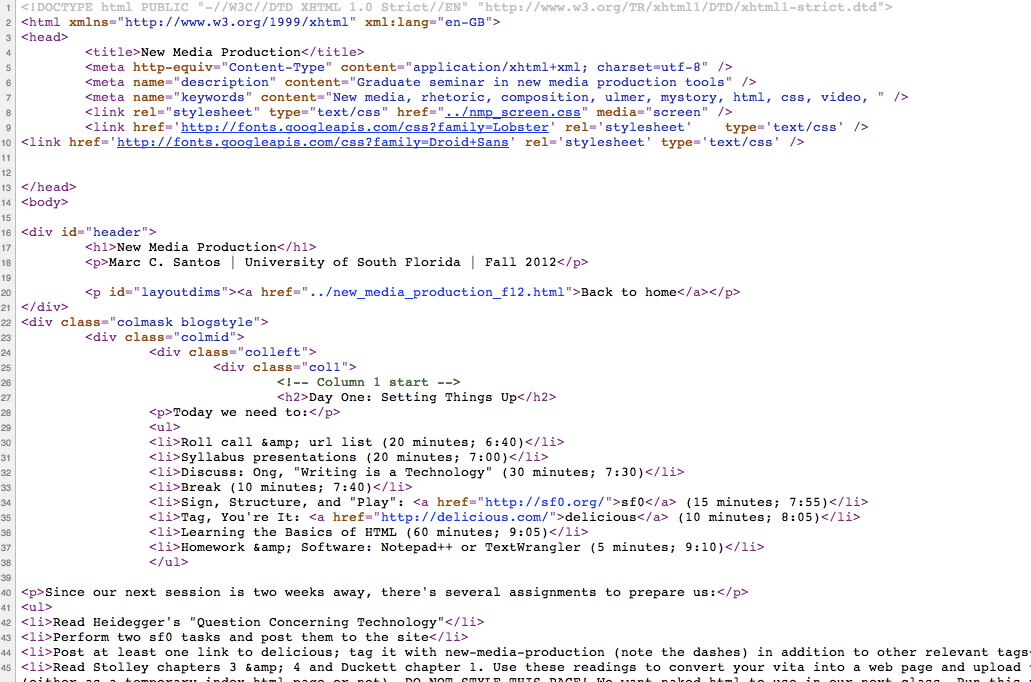
Let’s take a look at what some “naked” HTML looks like in a browser. If, in Chrome, we go to view > developer > view source we’ll see something like this:

code_screen_shot

So, what do we see in that screen capture? Well, we see all of the basic tags. We can think of this as the basic parts of speech for speaking HTML:

  • html & head: in lines 2 and 3, the html and the head tag appear. The html tag contains information for the browser. The head tag opens here. When looking at a web page, you can’t see any part of the head (with the exception of the title field). The head provides information for the browser to process the page. Including:
    • Doctype: The first line in the code is the DOCTYPE. This tells your browser what kind of code it is looking at. Whenever you start a new page, you can copy and paste this DOCTYPE line. For this class, we’ll be coding in the doctype xhtml 1.0 strict.
    • Title: The title tag determines what appears in the tab in your browser
    • Metadata: This is information for search engines (lines 5-7)
    • CSS: Lines 8-10 contain links to the cascading style sheet and google fonts; this is styling information. We’ll deal with CSS in our next class.
  • body: Notice that the head closes in line 13 and the body opens in line 14. The body contains:
    • content tags: all the content in a page basically appears in one of the following tags:
      • p – your basic paragraph tag. Use this for any text information
      • h1, h2, h3 – different headings. The h1 is the page’s main heading, h2 indicates a sub-heading, h3 a more minor heading.
      • ul & li – ul opens an unordered list, li puts an item in that list. Lists are a bit more tricky than paragraphs, but easy once you get the idea. Look at lines 29-38 to get an idea of how a list works (the unordered list opens, all the line items open and close, the unordered list closes)
      • img – check out line 53 for an example of how to insert an image
    • semantic tags – these tags reinforce/augment the meaning of text. It is your basic bold and italics. These tags have to appear within content tags (for an example, look at lines 50 or 55 of this page’s code–first the p opens, then the strong opens, then the content, then the strong closes, then the p closes.
      • em
      • strong
      • cite
      • blockquote
    • structural tags – throughout this page’s code, you’ll notice the following tags. Ignore them for now–they are structural tags that identify content for styling. Essentially, you use structural tags like the div or span tag to target specific content in your CSS sheet. Depending on how the next few weeks go, we might talk about CSS and structural tags later in the course–but for now you can basically ignore them.
      • div
      • class
      • span

I know the above reading is probably not too helpful for those of you just starting to code; so I want you to try and practice coding a document. Let’s jump into Notepad++, open a new document, and start coding. We need to:

  • Open close html
  • Open close the head
  • Open close the body
  • Put a title into the head
  • Put a metadata description in the head
  • Put a metadata keywords in the head
  • Open your sample page, copy/paste all the content in the resume into the body
  • Save the file
  • Preview the file
  • Apply some tags (h1, h2, p)
  • Save preview
  • Apply some more tags (ul li)
  • Save preview
  • Apply some more tags (strong, em)
  • We are not going to build a fracking table today.

Homework

Keep working on your project 2.

Read Katz’s article Ethic of Expediency. Pay particular attention to the epigraph at the very beginning. Answer two of the four questions on Canvas.

Posted in Uncategorized | Comments Off on ENG 201 5.W: HTML Primer

ENG 225 5.M: A Little Bit of Research

Today’s Plan:

  • Calendar Review
  • Grading Rubric
  • Office hours reminder
  • A Little Bit of Research
  • Homework

Calendar Review

Monday, February 4th: Computer Lab. Research on your game. Homework: craft a literature review.

Wednesday, February 6th: APA workshop. Homework: complete draft of Sicart paper. Bring a paper copy to class on Friday.

Friday, February 8th: Peer review Sicart drafts. Homework: Revised Sicart papers due Sunday at 11:59am.

Grading Rubric and Office Hours

I have customized my standard grading rubric for this project.

A reminder that I hold office hours on Tuesday from 12:30 to 3:00 in Ross Hall (office 1180D).

A Little Bit of Research

I wanted to take some time today and introduce you to resources to identify secondary research on your game. In some cases, you might find detailed analyses of your game to incorporate into your paper–for instance, someone else might have written about a scene in your game. Your body paragraph might point out how that analysis predicts what Sicart would say, or contradicts it. Perhaps, for instance, reading The Walking Dead from a Marxist/materialist perspective (like the article critiquing Mass Effect we read–that every decision becomes an economic decision motivated by “fitting into” capitalist and/or heteronormative economies).

Let’s head over to the library’s Summon portal.

Homework

We’ll meet back in this lab on Wednesday to work on APA format. Bring your copy of the Hacker and Sommers APA guide.

Posted in teaching | Tagged | Comments Off on ENG 225 5.M: A Little Bit of Research

ENG 329 4.F: Affective Objects Rubric

Today’s Plan:

  • Do you want me to look at your script?
  • Montage
  • Tips for Lighting and Sound
  • Field Trip
  • Homework

Affective Objects Rubric: Montage

Last class we talked about one core aesthetic element of filming: an opening shot. Today I want to follow that up by focusing attention on Schroeppel’s chapter on the montage. He defines a montage as a quick sequence of shoots in which “each shot is clearly different than the one before it.” He argues that a variety of angles and depths produces a stronger effect.

This, of course, isn’t the only way to produce a montage. Amontage is always a series of quick shots in rapid succession, but the purpose and meaning of a montage and really vary. A montage can be used to compress time, to juxtapose two different characters, narratives, or ideas, or to create a symbolic meaning.

Affective Objects Rubric: Lighting and Sound

In preparation for today, I asked you to read chapters 7 and 8 of the Schroeppel, which focus on lighting and sound. I want to break you into two teams, one that will discuss lighting, and the other that will focus on sound.

Lighting Questions:

  • What things should I keep in mind when I shoot outside? [Note that I do not expect folks to use a fill light]
  • Moving inside: What are hot spots? How can I provide softer light to avoid hot spots?
  • Where does a viewer’s eye typically go? How do I know if my lighting doesn’t work?

Sound questions:

  • What are the basic 3 kinds of mics?
  • Which of these are available via the library?
  • When is it ok to use a smartphone mic?
  • What is reverberation? How can I manage it?
  • What is a “wild effect”? How should I record one?

Schroeppel’s book targets folks who are getting into professional cinematography. For instance, his lighting section assumes that you have 4 different kinds of lights. Obvious we don’t. We are “working on the cheap.” But I do think it is possible to put his concepts into practice–and we can find a bunch of material on the internet aimed at helping folks shoot and record. The following page should help you think about lighting. This page should also help you think about lighting. This page should help you learn how to use a lavalier microphone.

Here’s a link to our project two workspace.

Let’s review the postmortem (and I might edit it).

Homework

Originally, I hoped to have time to storyboard some of your film today. As a writing teacher, I think of storyboarding as akin to outlining–you want to do some inventive “pre-writing” that lays out a map for your project. Of course, the final project might not resemble that initial outline, but I think it is important to start sketching out scenes and thinking about locations, angles, etc.

I’d like you to storyboard and shoot at least one scene for your video this weekend. start assembling and saving footage. These projects will be due Monday, February 11th. My plan for all three days in class next week is to work in Adobe Premiere–essentially class time will be dedicated to editing video while you work on shooting and editing outside of class.

Posted in Uncategorized | Comments Off on ENG 329 4.F: Affective Objects Rubric

ENG 225 4.F: Analysis Paper

Today’s Plan:

  • Calendar Review
  • Analysis Paper Expectations
  • Reading an academic article

Calendar Review

Friday, February 1st: Assignment details for the analytical paper. Homework: Play your game, write in your journal, invest 30 minutes into your paper.

Monday, February 4th: Computer Lab. Research on your game. Homework: craft a literature review.

Wednesday, February 6th: APA workshop. Homework: complete draft of Sicart paper. Bring a paper copy to class on Friday.

Friday, February 8th: Peer review Sicart drafts. Homework: Revised Sicart papers due Sunday at 11:59am.

Analysis Paper Expectations

Now it is time to draft and develop our first major paper: the ethical analysis paper. This paper will apply Sicart’s theory of ethical gaming to a specific game. Your task is to evaluate Sicart’s theory, to give the reader an argument as to whether game X is an ethical game according to Sicart’s criteria. At the same time, you might argue that game X is an ethical game despite the fact that it doesn’t match up with Sicart’s criteria. There is a range of possibilities for this paper–and it is impossible for me to anticipate how your game, your sensibilities, your arguments will play out.

But I can introduce you to the format of an analysis essay. They go something like this:

  • Introduction [What was the object of my analysis? What lens did I apply to it? What were the results?]
  • Literature Review [What have other writers said about this object?]
  • Theoretical Frame [What is my lens for examining something? What was I looking for/through? Upon what theory did I orient my examination?]
  • Results/Analysis/Application/Witty Names
  • Conclusion

I imagine you will want me to put a length on this paper. Note: teachers in writing studies HATE putting lengths on papers. Papers are as long as they need to be to say the things that have to be said. But in an effort to make you happy, I will suggest that this paper is conference length, which is 7-10 pages double-spaced, not counting the title page, abstract, or references list. That’s roughly 2000-3000 words. Your paper might be shorter than that. It CANNOT be longer. I will fail a paper that is longer than 3000 words.

Hopefully you see how the Sicart section can translate into the theoretical frame. You want to revise that Sicart material down and make sure you have two or three criteria to apply to your game. That could include:

  • The importance of player complicity and investment and how a game might develop them
  • The importance of meaningful choice and what makes a choice meaningful [FOR SICART]
  • The notion of cognitive friction and how SICART TRANSLATES A DESIGN CONCEPT INTO GAMING

I graded the Sicart papers according to some structural criteria, by I didn’t score the quality of your summaries. My marginal comments should indicate whether I think you have a workable framework. If I told you that a quote felt forced, or misrepresented, or was underdeveloped, then you have work to do. You have to re-read the Sicart (and use the index) and further develop your framework. Your framework has to read like a clear list of things that Sicart looks for in games.

I will provide a more extensive rubric for the paper on Monday.

Today I want to examine two published essays that can serve as structural models for your work.

Homework

Play. Read. Write. Revise.

I will have office hours Tuesday from 12:30 to 3:00. This is an opportunity to bring me a paper draft. To tell me “I don’t understand Sicart.” To ask me where Sicart discusses a specific idea.

Posted in Uncategorized | Tagged , , | Comments Off on ENG 225 4.F: Analysis Paper

ENG 329 4.W: Opening Shots, Project 2 Criteria

Today’s Plan:

  • Opening Shots
  • Project 2 Postmortem
  • Homework

Opening Shots

Let’s watch a quick video on the significance and craft of opening shots.

Project Two Postmortem

Let’s examine what I asked last semester.

Let’s figure out what I should ask you this semester.

In crafting postmortem questions, it might be useful to review our heuristic from last class.

The rubric for project two will repeat the following expectations/criteria from the first project and add a few more (some today, some Friday when we discuss the Schroeppel.

Homework

On Friday we will discuss Schroeppel chapters 6, 7, and 8. We’re going to use the Schroeppel to expand the criteria above.

Finish your script for the Affective Object project. We’re going to talk about storyboarding on Friday and sketch some pictures.

Posted in Uncategorized | Tagged , , | Comments Off on ENG 329 4.W: Opening Shots, Project 2 Criteria