ENG 201 1.W: Job Advertisement Corpus

Today’s Plan:

  • Questions
  • Quick Exercise: Professional Vs. Technical Writing
  • Introduction to mediabistro.com, job corpus
  • Setting up Google Docs
  • Homework

Questions

Class

  • Will there be a final in this class? Is the final determined through the several projects we do?
  • In relation to the articles we annotate and return to class, will we be tested on them in any way throughout the semester and will they be returned to us?
  • As for a question, I was wondering if we are going to cover any parts of the publishing process?

Academic Advising

  • What made you want to start your graduate studies in English? Do you have any tips for entering a graduate level program?
  • Is there any way you can get an associates degree for writing at UNC?
  • How does one go about gaining experience in the field of technical writing?
  • Before I graduate, I would love to intern with Make-A-Wish Foundation. All of the positions they offer require some background in technical writing […] The two positions that I am most interested in at Make-A-Wish is the Development Intern, which assists in grant-writing and research, and the Communications Intern, which specializes in social media outreach. In your professional opinion, what would be the pros and cons of both positions? I look forward to your response!
  • When it comes to questions wondering if I would be able to ask for your advice if there comes a time I may need it, whether it is for an assignment or something else.

Personal

  • Where are you from?
  • My question for you would be, when you were a freshman in college, what major did you originally want to pursue and what made you want to be an english professor?
  • If you didn’t teach in the English field, what would you teach?
  • What jobs have you had that have involved writing, literature, English of any sort?
  • As for my question it is more related to your Eng 225 class. What is your favorite game?
  • What is your zodiac sign?

Quick Exercise

I want you to spend 10 minutes and write me up a quick paragraph or two that defines and distinguishes Professional Writing vs. Technical Writing.

There’s a discussion forum in Canvas.

Sharing mediabistro.com Job Corpus

Your first project this semester dovetails with a current research project I have been working on. As we revise UNC’s writing minor, I have been curious as to what skills and technologies to focus on. This curiosity led me to research job advertisements for English majors, and Brumberger and Lauer stands as the most recent and comprehensive study I found. However, their article focuses on “technical communication.” This designation can have many meanings–sometimes it is merely a synonym for professional writing. But not in their case–they use (as do I) in the more precise sense of developing documentation and working with scientific experts to communicate scientific/technical knowledge. Our department doesn’t have someone with those specializations–so as much as I appreciate their research, I wanted something a bit more targeted. Their research speaks more to folks at large research institutions with Professional and Technical Writing major, more specialized faculty, and software licenses such as MadCap Flare or Adobe RoboHelp. We are a much smaller department with 4 tenure-track faculty (and none of us, I think, would claim Professional or Technical writing as a core specialization).

So I’ve turned my attention to Professional Writing jobs outside of technical writing (in either of the forms I’ve traced out above). During my research, I came across a specialized job listing site–mediabistro.com. From their “About Us” page:

Mediabistro is the premier media job listings site and career destination for savvy media professionals. Whether you’re searching for new job opportunities, striving to advance your career, or looking to learn new skills and develop valuable expertise, we are here to strengthen and support your professional journey. We have the tools and resources to help you navigate your own path and find career happiness.

In addition to job postings, mediabistro.com offers resume services and courses on professionalization and personal brand building. Rather than turning to a more popular site like monster.com like Brumberger and Lauer, I used mediabistro.com because it focuses specifically on jobs involving writing and communication.

I spent the month of June scanning every job ad posted to mediabistro.com. I filtered out jobs that:

  • Called for experience in television production (especially those that required years of on-air experience)
  • Called for extensive experience as a field journalist (although I retained jobs open to those without journalistic experience; a few jobs were looking for bloggers or content contributers)
  • Required degrees in finance or accounting
  • Required extensive experience with Google Ads and/or other Customer Relationship Management (CRM) softwares (Salesforce was particularly popular)
  • Required applicants bring a client log with them
  • Required management or hiring experience (the term management is quite slippery in adverts; sometimes it means “manage a team” and clearly indicates the need for leadership experience. Sometimes it means “manage our twitter account” and isn’t, per se, a leadership position)
  • Required backend coding skills
  • Required extensive graphic design portfolios (I did retain entry level graphic design jobs)
  • Required 5 or more years of experience
  • Telemarketing jobs, part-time jobs, or unpaid internships

After filtering out these jobs, I was left with a corpus of 375 jobs.

Over the next two weeks, you will code a total of 20 jobs from this corpus. I have selected 10 advertisements for us to code together; you will each select 10 other advertisements to create your own 20 ad corpus. We will use a modified version of Brumberger and Lauer’s coding scheme, which I will share with you on Friday.

Setting Up Google Docs

You will need a gmail account. Create a new gmail account using a pseudonym. I’m insignificantwrangler@gmail.com

Let’s look at Google Drive.

Homework

I would like you to go through the job corpus above and find 10 to which you would want to apply. Make sure they have at least 4 different first letters (weird, I know, but I want folks to scroll through the list). Download copies and then upload them to a Google Drive folder.

If you do not already have a gmail account suitable for job searching, then create a gmail account suitable for job searching.

Posted in teaching | Tagged , | Comments Off on ENG 201 1.W: Job Advertisement Corpus

ENG 225 1.W: Introduction to Ethics

Today’s Plan:

  • Office Hours
  • Introduction to Ethics / Project One
  • Setting Up a Google Doc
  • Homework

Introduction to Ethics

Today I want to give some sense of what constitutes ethics. I’ll start by attempting to differentiate ethics from morals. Both ethics and morals are a part of what we call practical philosophy–rather than dealing with “what is,” practical philosophy deals with how we should act, what should be. In simplest terms, then, both the study of ethics and philosophy deal with right and wrong. Generally, morality is thought to deal with personal convictions developed via abstract or religious/spiritual principles. Ethics are thought to be rules derived from “external” agencies–our secular social/institutional contracts. Murder, then, is both immoral and unethical. However, adultery is often immoral, but it isn’t necessarily unethical. By this distinction between morals and ethics, you can often determine the latter by asking “can I go to jail for this?”

I should say that I find this distinction between morality and ethics simplistic. I think of ethics otherwise.

For me, morality is the study of the rules that govern our behavior, our internalization of the rules, what we value and believe. The spiritual-internal vs. secular-external distinction isn’t particularly productive for me. Again, morality is how we develop and internalize the rules: thou shalt not kill. A moral.

Ethics, for me, signals how we employ, actualize, our moral values in lived experience. It is how we act. If morality is our sense of what should be, ethics is our study of how we actually act. Ethics operates in relation to morality, always in its shadow. I think the study of ethics is the most interesting when we encounter a situation in which or moral convictions come into conflict. If we believe that “thou shalt not kill,” then how do we also celebrate the soldier?

My understanding of ethics is heavily indebted to the work of philosopher Emmanuel Levinas. Levinas’s work encourages us to recognize our aversion to difference, and the lengths humans will go to eliminate alterity (that which is strange, different, unknown or unknowable to them). He jests that we have an allergy to the strange and different, to the other. We seek to joyously possess the world as a certain knowledge. To eliminate questions that make us uncomfortable. Rather than deal with the other, we desire the same–we desire to know, label, categorize, understand something. Facing something we do not know, or cannot know, brings out the worst in us. To be ethical, for Levinas, is to learn to inhabit this discomfort, disequilibrium. To welcome the other as an other, to let them be different, rather than to convert them into the “same” thing that I already know.

What does this have to do with the distinction between morality and ethics? I believe that the more we recognize and study ethics (as moments of moral indecision), the more we learn to choose when no one true, certain, “right” answer is evident, available, or even possible, the more ethical–the better people–we will become.

Ok, enough blather. Let’s talk about the Trolley Problem, created by Foot and complicated by Thompson.

Let’s play 4 quick choose your own adventure games.

Let’s try again.

So, if you haven’t guessed by now, here is my theory for what video games have learned is their unique province: they can leverage the emotional unrest, affectation, difficulty, disequilibrium of Trolley Problems. In a book or a film, we are left to watch the trolley driver pull the switch or not. The author decides. The author justifies. Perhaps she does so to secretly stir our outrage, to get us to deconstruct her flawed reasoning. She can spur reflection, contemplation, resistance. But we are always a bystander to the action, distanced from the choice. We are witness.

But not so in a game. I remember my first play through of Dragon Age: Origins. The details are a bit foggy–I remember encountering some elves and some werewolves. Maybe the werewolves were created by dark elven magic? And then, like Frankenstein’s monster, abandoned by their creators. Or maybe a wolf had killed and assaulted an elf? I honestly don’t remember. But I remember, unexpectedly, having to decide which species to exterminate. Only one can survive. Neither is innocent. And there is no heroic path to saving them both. I am responsible. I must pull the lever.

I’ve played games since roughly 1984 on my Atari 2600. I’ve murdered hundreds of thousands, if not millions of aliens and demons and terrorists and zombies and horde (“For the Alliance!”). I’ve killed all these things from a moral position that authorizes their death. I’ve never been troubled by all this killing. Those aliens threaten our light. Those demons threaten Tristram. Those terrorists threaten democracy. Those zombies would eat me and the few others remaining in Racoon City. I killed them all without friction. (Save for Silent Hill 3, one of the greatest mindfuck games of all-time unfortunately lost to history).

But Dragon Age interrupted my joyous possession of the world, my righteous action, my moral foundation. It stung me. This was something different.

I introduce the Trolley Problem, the lever, the notions of disequilibrium, ethics, and agency as a way of thinking about games. I imagine many of you are already thinking of games that leverage this dynamic. Soon we will work together to generate lists of games–AAA, mobile, indie–that we can play and explore as a class (in addition to my two required experiences: A Wolf Among Us and A Study in Steampunk.

Homework

For Friday’s class, I’d like you to read Sicart’s Introduction and chapter “Defining Ethical Gameplay.” Pay attention to how Sicart defines ethics and morality–how does his definitions compare to the ones I offer above? What does Sicart offer as guides for good ethical games/gameplay? What does Sicart identify as key terms, or dimensions, of ethical game play?

Spend 20 minutes writing about Sicart in your Google Doc. Generally, I would like you to try and generate two “questions” we could ask about games relevant to ethical gaming. Attempt to explicate 2 important quote from the text as the basis for your questions–put them in context (transition into them, etc). Essentially, I am measuring how well y’all know how to work with source material, explicate direct quotations, and site sources. Use APA format for in-text citations.

Posted in levinas, rhetoric, teaching, Uncategorized | Tagged , , | Comments Off on ENG 225 1.W: Introduction to Ethics

ENG 329 1.M: Course Introduction

Today’s Plan:

  • Syllabus
  • Introduction Assignment
  • Google Form

Syllabus Review

Here is a link to the syllabus.

Introduction Assignment

For your first assignment, I’d like you to post a short video (30 seconds or less) that introduces you to the class. Perhaps you might begin by letting us know your major and career goals. But the focus of the video should be on sharing a part of your life that is important to you. It can be a place, a book, a food, an activity, anything you can film.

I don’t want anyone to worry about quality or freak out and drop the course! This is a way of me getting a sense of what you are capable of. In any course–but especially a course working with technology–it is a challenge to measure every student’s incoming abilities. This activity is meant to help me do just that.

A brief aside on the significance of imperfection.

Before you shoot your project, let’s spend a little time with Steve Stockman, author of How to Shoot Video that Doesn’t Suck. Stockman provides us with five basic principles for shooting video:

  • shots should be 10 seconds or less
  • Whites of their eyes (faces)
  • Light behind the camera, not behind the subject
  • Keep the camera still, don’t shoot and move
  • Keep your video short

If you are unsure what Stockman means by shots, maybe this will help.

Also, if you can, include some background music.

You can use any editor you want to make these videos, even iOS apps.

You should create a YouTube account and use the YouTube button in the discussion tools to embed your video into a discussion post. (Note try the embed, if you are having trouble then use a link).

Bat Dad

Heart Shaped Box cover

Kevin Clark slow news day

Homework

There’s a discussion post on Canvas where you can upload your video (or, if you are having problems, you can submit a link).

In Wednesday’s class, I was going to spend 20 minutes or so going over some simple image editing in Photoshop. Please take this survey ASAP so I know what to include in the workshop.

Posted in teaching | Tagged , , | Comments Off on ENG 329 1.M: Course Introduction

ENG 201 1.M: Intro and Intros

Today’s Plan:

  • Syllabus and Stuff
  • Reading ABO on emails, UNCO Style Guide
  • Composing and Sharing Emails
  • Homework

Syllabus and Stuff

Let’s take a look at the ENG 201 Syllabus.

A First Day Assignment

The first genre we are going to work with this semester is emails. I expect all correspondence between us to reflect the principles laid out by ABO on pages 164-168.

A few other resources for today:

I’d like you to compose a short email to me (marc dot santos at unco dot edu) that does three things:

  • introduces yourself (and your academic/professional trajectory) and
  • explains your interest in the course (what are you hoping to learn? why are you here?)
  • asks me a question that I can answer

I’ll give you time to compose your emails and then we will read them collectively as a class.

Homework

To prepare for project one, read Brumberger and Lauer’s (2015) “The Evolution of Technical Communication: An Analysis of Industry Job Postings.” You can find a .pdf of the file in Canvas (Files section). I would like you to print out a physical copy of the article and annotate it as you read.

By annotate, I mean I would like you to write comments in the margins and on top of the page. There’s a lot of different methods for annotating, and I wouldn’t force any one method on you. I tend to underline text that either highlights the author’s purpose/argument or that I find difficult or disagree with. BUT every time I underline something, I try to write a word or phrase at the top of the page that captures the essence/importance of that passage. Underlining without writing isn’t useful. Writing notes in the margins helps with retention and comprehension. Throw away your highlighter.

After you read and annotate, please post a 150-250 word response to the article in Canvas. In the future, I might ask you to focus your response on a specific element of a reading. For our first reading, I simply want to know what in the article surprises you. I also want to know what else you wished the author’s elaborated.

Posted in teaching | Tagged , | Comments Off on ENG 201 1.M: Intro and Intros

ENG 225 1.M: First Day

Today’s Plan:

  • Syllabus: Required Materials
  • Let’s Talk About GamesArt
  • Homework

Let’s Talk About Games and Art

This is the third time I’ve taught this course. The previous two times, I opened with a project built around Roger Ebert’s tired article “Video Games Can Never Be Art.”. Essentially, students dismantled Ebert’s opposition to considering games as art by emphasizing how a specific game reflected Aristotle’s notions of mimesis or catharsis. We are going to do this, because it is a bit too much like shooting fish in a barrell. But I do want to talk about mimesis and catharsis today. My idea here is to provide us with an initial lens for thinking about what games do to us (ideologically), how they shape the ways we see ourselves and think about our world.

Mimesis

The stock definition of the ancient Greek term mimesis is “imitation,” though the more precise philosophical sense, attributed to Plato and Aristotle, is often “representation.”

Plato, Aristotle’s teacher, was suspicious of art because it was merely mimesis– that is, representation of the material world (which itself is a mere representation of a transcendental Ideal/divine world). For Plato, being a representation (a copy, an imitation) was a pejorative. Anticipating Karl Marx by about 2000 years, Plato believed art was a kind of opiate that distracted people from engaging more important questions and problems.

Aristotle rejects Plato’s condemnation, and argues that mimesis is superior to reality (or that art is superior to history). The artist has the power to represent things not as they are, but as they should be or as they could be. This is how I interpret Aristotle’s argument that art represents “men in action” either “better than in real life, or […] worse” (I.10.a). This exaggeration provides art with its pedagogic potential–the core to Aristotle’s defense of art. Sometimes in the real world, evil prevails. But art can be better than the real world–the artist can ensure a moral ending.

Beyond such moral/pedagogic potential, however, Aristotle believes that the representations we encounter in art shape who we are and how we learn to navigate the world:

Poetry in general seems to have sprung from two causes, each of them lying deep in our nature. First, the instinct of imitation is implanted in man from childhood, one difference between him and other animals being that he is the most imitative of living creatures, and through imitation learns his earliest lessons; and no less universal is the pleasure felt in thing imitated.

To understand what Aristotle means by contributing to our advancement and learning, one must recognize the difference between plot and theme, what Aristotle designates as the difference between “narrative” and “action.” This gets us at the heart of what art imitates–what is the “action” of a poetic drama (which in Ancient Greece is a catch-all term for all artistic production). Plot is what happens in the narrative. Theme indicates what the narrative “is about.” To be more explicit: what general problem/tendency of the human condition does this particular story address? What does it teach us of the struggle to be human? to be better? to live the good life? So by mimesis, imitation, representation Aristotelian aesthetics points to how (or whether) a piece of art instructs on how to live a good life. Art shows us examples of characters (ways of being in the world), and–as we will see below in the discussion of catharsis–it often provides us with models for how to respond (or, in the case of tragedy, how not to respond) to the challenges of human existence.

When writing about the games you play in your gaming journal this semester, one thing to pay attention to is representation: what human archetypes does the game present?
What questions of human existence does it pose? Upon what themes does it tread?

Catharsis

Above, Aristotle referenced the “pleasure” experience via art as one of the two primary causes for poetry. Pleasure here must be scare quoted, because often the impact of aesthetic works isn’t necessarily enjoyable. Aristotle is approaching one of those timeless introductory questions to the humanities: why do we enjoy things that make us cry?

His answer is catharsis, the process which, by watching/experiencing a narrative of struggle with which we identify, we are able to purge ourselves of those emotions. He writes:

Tragedy, then, is an imitation of an action, that is serious, complete, and of a certain magnitude; in language embellished with each kind of artistic ornament, the several kinds being found in separate parts of the play; in the form of action, not of narrative; through pity and fear effecting the proper purgation of these emotions. (VI. 1-2)

Of course, there is something memetic or pedagogical going on here as well–we are learning the proper way to handle those difficult situations in life. But we are also releasing frustrations. This, Aristotle argues, is essential to human life. Gain and struggle are unavoidable. Art not only teaches us how to deal with such difficulties, but also helps us cope with the frustrations we accumulate on a daily basis.

As you are playing, be on the lookout for cathartic moments. Pay attention to when you feel anxious, stressed, sad, angry, joyous. Pay attention to the way a game is designed to make you feel.

A Quick Exercise

Games and art.

Homework

Purchase the Sicart book and Telltale’s The Wolf Among Us.

Posted in Uncategorized | Tagged , , | Comments Off on ENG 225 1.M: First Day

ENG 201 15.T: End of Year

Today’s Plan:

  • Honest Conversation by way of a quick Google Poll
  • Reviewing the Web Presence Project
  • Peer Review
  • Linkedin follower party
  • Class Picture
  • Course Evaluations

Honest Conversation by way of a quick Google Poll

Please answer two questions.

Review the Web Presence Project

My expectations for your web presence project:

  • A graphic and engaging website that contains
    • An “About Me” or personal description
    • A resume
    • A portfolio of at least four works with some level of textual splash/blurb/description
    • Contact information, including links to professional social media
    • Something else?
  • A Linkedin account that contains
    • Education
    • Skills section
    • Location
    • Summary Statement / Elevator Pitch (40-50 words)
  • One more relevant and or cool thing–another social media account that actually has relevant content, a blog with some posts, something?

When is this due? Answer: when do you want to finish it?

I feel I’ve commanded enough of your time before break that I can be flexible these last two weeks. I will accept these projects until Sunday December 9th at midnight. If you turn the project in early, I’ll grade that version. If you don’t like your grade, you can resubmit the link.

Posted in Uncategorized | Tagged , | Comments Off on ENG 201 15.T: End of Year

ENG 122 15.M: End of Year

Today’s Plan:

  • MLA / APA Exercise Note
  • Review Multimedia Assignment
  • Draw Lots
  • Review Final Papers

MLA / APA Exercise Note

I got a few emails from folks who didn’t submit this the day we worked on it in the lab. This shouldn’t be an issue, because we worked in Google Docs. Just submit the shareable link to Canvas and I can give you credit.

Review Multimedia Assignment

So, multimedia presentation requirements:

  • 125-150 word script
  • 12-15 images on screen for 5 seconds each
  • Quality audio recording of your speech (note: double and triple check volume levels)
  • Title text on screen
  • Bonus: background music
  • Upload to Youtube / Share Youtube link on Canvas (“Multimedia Presentation”)

Screen Shot 2018-11-12 at 9.11.54 AM
Screen Shot 2018-11-12 at 9.22.34 AM

IMPORTANT NOTE ON SAVING PROJECTS IN ANY VIDEO EDITOR: Finally, when working with video, it is extremely important to stress file saving and storage. While programs like OpenShot or MovieMaker claim to “import” files, they are actually only creating paths to other media. This means that when you save a movie file, you are saving paths to other files. If you then move the movie file, you have invalidated all the paths (the dreaded Microsoft Red X’s of death). In plainer language, you’ve lost your whole movie.

This is especially an issue for students working in computer labs and saving files on a flash drive. The easiest way to make sure this doesn’t happen is to create a folder when you start a movie project and save all image, audio, and video files in the movie in that folder. That way, all the files move at once.

When you are done with your video and want to submit it, then you need to export the video.. There’s a lot of file formats you can use to save a video. I recommend .mp4 because it is a universal file type. If you use Moviemaker, then it will export as an .wmv. That’s fine too. Just make sure you don’t try to share or submit the project file to Canvas–that file only works in a video editor (and, again, only if it is still connected to all the files that were used to make the video).

Finally, I’ll ask you to upload a final version of your video to Youtube and submit a link to the Youtube video to Canvas. This should help ensure that no one attempts to upload a project file, and should quicken watching the videos on Wednesday and Friday.

Review Final Papers

I’ve been working through the drafts. I have thoughts.

Does your Work Cited / Reference have page numbers but your in-text citation does not?

APA, electronic sources, paragraph numbers.

Abstract doesn’t replace intro

Homework

Complete your multimedia presentation.

Revise your paper. Final papers are due Wednesday, Sept. 5th at midnight.

Complete your online course evaluations.

Posted in Uncategorized | Comments Off on ENG 122 15.M: End of Year

ENG 201 12.T: Web Presence and Portfolio

Today’s Plan:

  • Web Presence and Portfolio
  • Homework

Web Presence

For the final component of our Job Materials project, I want you to develop both an online web presence and a portfolio. What do I mean by web presence? What belongs in a portfolio? What can I use to put these together?

Let’s comb through some relevant readings and carve out answers:

My expectations for your web presence project:

  • A graphic and engaging website that contains
    • An “About Me” or personal description
    • A resume
    • A portfolio of at least four works with some level of textual splash/blurb/description
    • Contact information, including links to professional social media
    • Something else?
  • A Linkedin account that contains
    • Education
    • Skills section
    • Location
    • Summary Statement / Elevator Pitch (40-50 words)
  • One more relevant and or cool thing–another social media account that actually has relevant content, a blog with some posts, something

Homework

Make sure there’s a copy of your cover letter in the Professional Workspace google doc link you submitted to Canvas. After noon on Thursday I’ll be printing copies of all your cover letters for workshopping in class on Thursday.

There will be no class the Tuesday before Thanksgiving. Work on the portfolio outlined above. We’ll peer review these portfolio sites in class on the Tuesday after the Thanksgiving break. We will also do course evaluations that day–since this is such a small class, it would be great if everyone could be there!

Posted in teaching, technology | Tagged , , , | Comments Off on ENG 201 12.T: Web Presence and Portfolio

ENG 122 12.M: Return of the Rubric

Today’s Plan:

  • Schedule Update
  • Creating a Multimedia Presentation
  • Return of the Rubric
  • Homework

Schedule Update

I made a few changes:

  • Monday, Nov 12th: Return of the Rubric
  • Wednesday, Nov 14th: Creating a multimedia presentation and MLA/APA citation
  • Friday, Nov 16th: Complete academic research paper due in class for peer review Ross Computer Computer Lab
  • Monday, Nov 19th: Optional class. Complete drafts of final paper due to me by Tuesday, Nov 20th at midnight
  • Monday, Nov 26th Review: creating a multimedia presentation
  • Wednesday, Nov 28th: Presentations #1-10
  • Friday, Nov 30th: Presentations #11-20
  • Monday Dec 3rd – Friday Dec 7th: Office hours availability to discuss revisions. Final papers are due Friday Dec 7th at 11:00am

I’ve set up a portal in Canvas for you to submit the draft of your final paper we will peer review in Friday’s class (Rough Draft, Due Friday Nov 17th and Tuesday Nov 20th). This is also the link that I will use to assess your paper over Thanksgiving Break. You’ll get 1 point if the draft is there Friday morning, the other four points will be the result of my draft assessment.

Creating a Multimedia Presentation

Remember that our last two classes of the semester–Wednesday Nov 28th and Friday Nov 30th–will be dedicated to watching multimedia remediations of your papers.

In terms of length, your final papers should be 1700-2000 words (excluding the title page and the works cited/reference list). Your presentations need to be much more concise; I want the videos to be 60-75 seconds. That means you get 125-150 words. Those words need to compress your argument, evidence, and recommendations/conclusions. This type of compression is quite difficult!

In terms of genre, I expect your video to be a modified PechaKucha, a popular presentation format that uses 20 images for 20 seconds each. We’ll look at an example of a PechaKucha on Wednesday. Here’s our modification: I want you to use images for 5 seconds each. 20 seconds is too long to leave anything on a screen. So, if you do a 60 second speech, that’s 12 images. 75 seconds would be 15 images.

In terms of technology, I recommend using a free, open-source software called OpenShot to put these videos together. If you have an older PC, you might have Windows Moviemaker–that’s an incredibly easy software to use. If you have a Mac, then you have iMovie (note that iMovie is also available for iOS). Don’t use PowerPoint to do this–there’s much better technologies that are easier to use.

Besides arranging images and setting their length to 5 seconds, you’ll need to record yourself reading your script. If you have an iPhone, then you have an App called Voice Memos. This app produces a pretty high quality recording that you can email to yourself and then import into your project.

So, multimedia presentation requirements:

  • 125-150 word script
  • 12-15 images on screen for 5 seconds each
  • Quality audio recording of your speech (note: double and triple check volume levels)
  • Title text on screen
  • Bonus: background music

Screen Shot 2018-11-12 at 9.11.54 AM
Screen Shot 2018-11-12 at 9.22.34 AM

IMPORTANT NOTE ON SAVING PROJECTS IN ANY VIDEO EDITOR: Finally, when working with video, it is extremely important to stress file saving and storage. While programs like OpenShot or MovieMaker claim to “import” files, they are actually only creating paths to other media. This means that when you save a movie file, you are saving paths to other files. If you then move the movie file, you have invalidated all the paths (the dreaded Microsoft Red X’s of death). In plainer language, you’ve lost your whole movie.

This is especially an issue for students working in computer labs and saving files on a flash drive. The easiest way to make sure this doesn’t happen is to create a folder when you start a movie project and save all image, audio, and video files in the movie in that folder. That way, all the files move at once.

When you are done with your video and want to submit it, then you need to export the video.. There’s a lot of file formats you can use to save a video. I recommend .mp4 because it is a universal file type. If you use Moviemaker, then it will export as an .wmv. That’s fine too. Just make sure you don’t try to share or submit the project file to Canvas–that file only works in a video editor (and, again, only if it is still connected to all the files that were used to make the video).

Return of the Rubric

I feel like it has been awhile since we’ve spent time with our class rubric. Since you are in the process of drafting your final papers, I thought it might be time to assess a few papers from previous semesters.

Homework

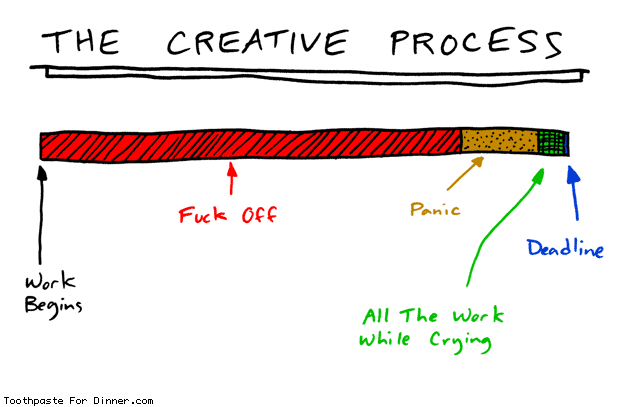
Let’s look at this helpful image from ToothPaste for Dinner that describes the writing process.

Get crying people.

Posted in teaching, technology | Tagged , , , | Comments Off on ENG 122 12.M: Return of the Rubric

ENG 201: Professional Development Project

Today’s Plan:

  • Outline Professional Development Project
  • Focus on Resumes

Professional Development Project

For the rest of the semester we will be working to assemble materials you will need for a job search. I expect you to produce:

  • A job ad analysis
  • A resume
  • A cover letter
  • A web presence with portfolio
  • A Linkedin account

This week we will focus our attention on two things: producing a job ad analysis and a resume that fits it. Next week we will work on producing a cover letter for the job ad. Finally, we will develop a personal website with a portfolio of work.

Resumes

I think one of the hardest things about teaching resumes is that everyone believes they know how to make one–that resumes are easy. I want to begin by suggesting that resumes aren’t easy–and that making a quality resume is quite hard. It is hard for a number of reasons. First, the resume has to survive the six second scan. Second, the resume has to be designed for both human and machine processing. Third, the resume has to be tailored to a specific job. You have limited space, every word on a resume has to have a rationale for being there.

Further complicating the process–the more instructive materials you read on resumes, the more you are likely to encounter contradicting advice.

Let’s start with the six second scan. Research shows that the average HR director isn’t going to spend 5 minutes combing over your resume. A preliminary scan is likely to be 10 seconds or less. A stack of 100 resumes might need to be reviewed in order to produce a list of 6 candidates for phone interviews. No one has 500 minutes to dedicate to that stack.

According to the Time article above, TheLadders has 6 principles for maximizing your chances of surviving the six second scan:

  • Don’t be creative. “So make sure these six items are easily digestible: your name, your current title and company, your previous title and company, your previous position start and end dates, your current position start and end dates, and education.”
  • Put Your Expertise and Skills at the Top. “These are the things that you’ll ultimately be bringing to any new employer, so make sure they’re near the top where a recruiter can easily see them. Use action verbs when describing your accomplishments and back it up with quantitative data when you can. For example, say that you increased sales by 30%, or that decisions you made led to a 150% decrease in operational costs. This is the area where you should feel free to go in depth.”
  • Don’t Make it Too Long. Some say you don’t want to go past one page, but there’s no real harm in going to two pages – especially if you’re older and have much more experience than a kid just coming out of college. Include as much as you can without making your resume appear cluttered.
  • Ditch the Photos. “If you only have six seconds, you don’t want them distracted,” Evans says. So get rid of any photos you may have attached to your resume, and don’t try any video gimmicks. It’ll come off as, well, a gimmick. “You don’t want people focused on your face and not your skills,” he says.
  • Don’t Focus on Your Personal Achievements. It’s great that you’ve played the tuba since high school and that you ran a 10K last fall. But don’t spend too much time playing up your more personal info. That sort of light-hearted information is likely to come up in face-to-face interviews anyways.
  • 6. Have it Professionally Made. You might be able to skip the first five steps if you follow this one. “I believe there are three things you don’t want to do on your own,” says Evans. “Don’t do your own taxes, don’t write your own will, and don’t do your own resume.” You may want to write the first draft, but consider taking it to a professional for the final touches. While (not surprisingly) TheLadders has resume writing services, there are many others, including Resumes Planet and Your Resume Partners. These services start as low as around $50 and can go as high as a couple hundred. But for around $100 you can generally get a quality edit and even an entire resume written up for you.

As the last paragraph stresses, TheLadders is attempting to promote a service–and I have some questions about their research. But, in general, these are all fine principles for crafting a resume. But the tricky part is that, depending on the specific job advertisement you have, I can think of occasions when I would recommend breaking all of them. The crafting of a resume is intimately tied to the analysis of a specific job ad–and buttressed by research into the company and or person who might be hiring you. What kind of company is this? Who are they looking to hire?

Here’s a second reading on surviving the six second scan.

Let’s move on to the second difficulty I outline above: preparing your resume for machine reading, or the ATS (applicant tracking system software, see ABO 500-01). Top Resume offers some nuts and bolts:

  • Stick with .doc or .docx files when uploading a resume rather than a .pdf (and, if it is a .pdf, make sure it is accessible).
  • Don’t use document headers or footers for personal information (including contact information)
  • Simple bullets only
  • Minimalist design with strong visual hierarchy (contrast)
  • Focus on keywords
  • Repeat key words

I want to focus on the final bullets here–keywords–because that crosses us over into analyzing a job ad. First, while I’ve already talked about the importance of concision, I also want to stress the importance of repeating keywords–they might appear in your Objectives section and then again in your Work Experience and then again in your Skills section. Even if you are designing for a human, it is ok to be repetitive with keywords and skills. Redundancy is strategic given the rhetorical situation.

How can we identify keywords? Let’s turn to SquawkFox.

Also: basic resume formats.

Thinking about the ABO reading:

  • Be truthful
  • GPA
  • Academic clubs-affiliations (494)

Potential section headings:

  • Heading (name and contact information)
  • Objective Statement (See 496-497)
  • Qualifications Summary (Professional Profile, Key Attributes)
  • Education (Academic Background, Certifications)
  • Employment Experience (Internships, see 498)
  • Related Knowledge / Relevant Skills
  • Honors and Activities (Professional Affiliations, Volunteer Work, Networking Assets, Awards, Recognitions, Notable Contributions, Publications)
  • References (?) Portfolios (We will do this online)

Homework

Locate a job for which you want to apply. You may use a job from Project One, or find a more recent and relevant ad using mediabistro.com, monster.com, ziprecruiter.com or any other job site.

Once you have found a job, conduct a keyword analysis to identify 8 words, phrases, skills, etc that have to be included in your resume.

Set up a Google Doc. Title it yourname-professional-workspace. Set the document to “anyone with the link can edit.” Submit the share link to Canvas. This document should contain a link to your job ad and your keyword analysis.

Begin revising your resume. Think about what sections you want to highlight. Think about design.

Posted in Uncategorized | Tagged , , | Comments Off on ENG 201: Professional Development Project